
Research Methods and Applications in Social Sciences: From Inquiry to Impact
Prof.( Dr.) Jai Singh, Dr. Manish Kumar Singh
Paperback
• 336 Pages
• inr 590.00
• English
• 9789349566613
No ratings yet
| Publisher | Bharti Publications |
|---|---|
| Brand/Group | Bharti Publications |
| ISBN13 | 9789349566613 |
| ASIN/SKU | 9349566613 |
| Book Format | Paperback |
| Language | English |
| Pages | 336 |
| List Price | inr 590.00 |
| Publishing Date | 22/09/2025 |
| Dimensions | 15.5 x 2.5 x 23.5 |
| Weight | 400 |
| Book Code | BD00069489 |
Buy this Book
Amazon Stores
Ebook Stores
Other Stores
Discover Research Methods and Applications in Social Sciences: From Inquiry to Impact by Prof.( Dr.) Jai Singh. This book is published by Bharti Publications in Paperback format, ISBN 9789349566613, ASIN 9349566613, under Social Sciences, Research.
Book Description
Research Methods and Applications in Social Sciences: From Inquiry to Impact is designed as both a comprehensive introduction to research methodology and apractical resource for applying research in diverse contexts.
Structure and Flow
Part I: Foundations of Social Science Research – Inquiry, problem identification, objectives, and variables.
Part II: Hypotheses, Sampling, and Approaches – Formulating hypotheses, sampling techniques, and quantitative vs. qualitative approaches.
Part III: Research Designs – Quantitative (descriptive, survey, ex-post facto, experimental) and qualitative (case study, ethnography, content analysis, phenomenology, historical, meta-analysis).
Part IV: Tools and Techniques – Data collection strategies and qualitative interviewing.
Part V: Designing and Proposing Research – Frameworks for research design and proposal writing.
Distinctive Features
Pedagogical clarity with examples and case studies.
Collaborative authorship offering diverse perspectives.
Applied focus on policy and social relevance.
Flexible use: chapters can be read sequentially or individually.
Structure and Flow
Part I: Foundations of Social Science Research – Inquiry, problem identification, objectives, and variables.
Part II: Hypotheses, Sampling, and Approaches – Formulating hypotheses, sampling techniques, and quantitative vs. qualitative approaches.
Part III: Research Designs – Quantitative (descriptive, survey, ex-post facto, experimental) and qualitative (case study, ethnography, content analysis, phenomenology, historical, meta-analysis).
Part IV: Tools and Techniques – Data collection strategies and qualitative interviewing.
Part V: Designing and Proposing Research – Frameworks for research design and proposal writing.
Distinctive Features
Pedagogical clarity with examples and case studies.
Collaborative authorship offering diverse perspectives.
Applied focus on policy and social relevance.
Flexible use: chapters can be read sequentially or individually.
Author Biography
Prof. (Dr.( Jai Singh is Professor in the Department of Education, Vasanta College for Women, Banaras Hindu University (BHU), Varanasi. With over 17 years of teaching experience in higher education, he has been actively engaged in preparing prospective teachers at the B.Ed. and M.Ed. levels. He holds advanced degrees including M.Sc. (Mathematics), M.A. (Sociology), M.Ed., PGDCA, M.C.A., and a Ph.D. in Education, earned from distinguished institutions such as the University of Allahabad and Banaras Hindu University. His primary areas of academic interest include Mathematics Education, Research Methodology, Assessment for Learning, Computer Programming and the integration of ICT in teaching and learning. He has published extensively in reputed national and international journals, including Scopus-indexed and UGC CARE-listed journals, and has contributed chapters to several edited volumes. Dr. Singh is the author of six scholarly books and co-editor of two volumes.
Dr. Manish Kumar Singh is currently serving in the Basic Education Department (Government of Uttar Pradesh) Barabanki. He has dedicated nine years to higher education, focusing primarily on the training and development of B.Ed. students. He possesses a strong academic background with degrees of M.A. (History), M.A. (Education), M.Ed., and Ph.D. in Education, from reputed institutions such as the University of Allahabad and Dr. R.M.L.A.U., Ayodhya. His professional engagements reflect a broad spectrum of interests, with a strong inclination towards research methodology, construction and standardization of tools, assessment for learning, and the meaningful integration of ICT in classroom practices. He has to his credit several research publications in well regarded national and international journals.
Dr. Manish Kumar Singh is currently serving in the Basic Education Department (Government of Uttar Pradesh) Barabanki. He has dedicated nine years to higher education, focusing primarily on the training and development of B.Ed. students. He possesses a strong academic background with degrees of M.A. (History), M.A. (Education), M.Ed., and Ph.D. in Education, from reputed institutions such as the University of Allahabad and Dr. R.M.L.A.U., Ayodhya. His professional engagements reflect a broad spectrum of interests, with a strong inclination towards research methodology, construction and standardization of tools, assessment for learning, and the meaningful integration of ICT in classroom practices. He has to his credit several research publications in well regarded national and international journals.
Editorial Reviews
Editorial Reviews will be added soon…
Book Summary
Research Methods and Applications in Social Sciences: From Inquiry to Impact is a comprehensive and practice-oriented guide that equips students, researchers, academicians, and professionals with the essential knowledge and skills required to conduct rigorous and meaningful research in the social sciences. In an era where evidence-based decision-making shapes public policy, governance, education, business, and community development, the ability to design, execute, and communicate quality research has become increasingly important. This book bridges the gap between theoretical understanding and practical application by presenting research methodology in a clear, systematic, and accessible manner.
The book recognizes research as a dynamic process of inquiry that enables scholars to explore social realities, understand human behaviour, identify patterns, and propose solutions to contemporary challenges. Rather than presenting research as a purely academic exercise, it demonstrates how well-designed studies contribute to informed policymaking, institutional development, and social transformation. Through carefully structured chapters, practical illustrations, and real-world examples, the book empowers readers to move confidently from identifying research problems to generating impactful outcomes.
The volume is organized into five coherent parts that collectively guide readers through every stage of the research process.
Part I: Foundations of Social Science Research introduces the philosophical and conceptual foundations of research. It familiarizes readers with the nature, purpose, and significance of scientific inquiry while explaining how research contributes to the generation of knowledge in the social sciences. The section discusses the process of identifying research problems, formulating objectives, defining variables, and developing research questions. By emphasizing the importance of clarity in conceptualization and problem identification, this section lays a strong foundation for conducting systematic investigations.
Part II: Hypotheses, Sampling, and Approaches explores the essential methodological decisions that shape the quality of research. Readers learn how to formulate meaningful hypotheses, distinguish between different types of variables, and understand the relationship between theoretical assumptions and empirical testing. The book provides detailed explanations of probability and non-probability sampling techniques, helping researchers select appropriate samples for different contexts. It also offers a balanced discussion of quantitative and qualitative research approaches, highlighting their strengths, limitations, and complementary nature. This enables readers to make informed methodological choices based on the objectives and nature of their studies.
Part III: Research Designs presents an extensive overview of both quantitative and qualitative research designs commonly used in the social sciences. Quantitative designs such as descriptive research, survey research, ex-post facto studies, and experimental research are explained with practical examples that illustrate their application in real-world settings. The qualitative section introduces readers to approaches including case study research, ethnography, phenomenology, content analysis, historical research, and meta-analysis. Each design is discussed in terms of its objectives, procedures, advantages, and limitations, enabling readers to select the most appropriate framework for investigating complex social phenomena. By presenting diverse research designs within a single volume, the book encourages methodological flexibility and interdisciplinary thinking.
Part IV: Tools and Techniques focuses on the practical aspects of data collection and analysis. Recognizing that the quality of research depends largely on the reliability and validity of collected data, the book introduces various data collection methods, including questionnaires, schedules, observation, interviews, focus group discussions, and documentary analysis. Particular emphasis is placed on qualitative interviewing techniques, helping readers understand how to design interview protocols, build rapport with participants, and generate rich, meaningful data. The discussion combines theoretical guidance with practical tips that enable researchers to address ethical considerations, minimize bias, and improve data quality.
Part V: Designing and Proposing Research serves as a practical roadmap for transforming research ideas into structured projects. This section guides readers through the process of preparing research designs, conceptual frameworks, literature reviews, and research proposals. It explains how to organize different components of a proposal, justify methodological choices, establish timelines, and present research plans in a logical and persuasive manner. Whether preparing academic dissertations, funded research projects, or institutional studies, readers gain practical insights into producing well-structured and professionally written proposals.
One of the distinguishing strengths of this book is its pedagogical approach. Complex methodological concepts are explained in simple language without sacrificing academic rigour. Each chapter incorporates examples, illustrations, and case studies that help readers connect theoretical concepts with practical situations. This learner-friendly presentation makes the book suitable for beginners while also providing sufficient depth for advanced researchers seeking methodological refinement.
Another significant feature is its collaborative authorship, bringing together diverse academic perspectives and experiences. The multidisciplinary expertise of the contributors enriches the discussion by presenting multiple viewpoints on research design, methodology, and application. This diversity reflects the interdisciplinary nature of contemporary social science research and encourages readers to appreciate different methodological traditions.
The book also distinguishes itself through its strong applied orientation. Beyond teaching research techniques, it demonstrates how research findings can influence public policy, organizational decision-making, programme evaluation, and community development. By consistently linking research methodology with real-world applications, the text reinforces the idea that high-quality research serves as a catalyst for positive social change and evidence-based governance.
Its flexible organization further enhances its usefulness. While the chapters are arranged sequentially to provide a logical progression through the research process, each chapter is sufficiently self-contained to be used independently. This allows instructors to customize course content according to curriculum requirements and enables readers to consult specific topics as reference material without necessarily reading the entire volume.
Overall, Research Methods and Applications in Social Sciences: From Inquiry to Impact serves as both a foundational textbook and a practical handbook for research methodology. By integrating conceptual understanding with methodological skills and emphasizing the practical application of research, it prepares readers to conduct ethically responsible, scientifically rigorous, and socially relevant investigations. Whether used in undergraduate and postgraduate programmes, faculty development initiatives, policy research, or professional training, the book offers a valuable resource for anyone seeking to transform inquiry into meaningful knowledge and lasting societal impact.
The book recognizes research as a dynamic process of inquiry that enables scholars to explore social realities, understand human behaviour, identify patterns, and propose solutions to contemporary challenges. Rather than presenting research as a purely academic exercise, it demonstrates how well-designed studies contribute to informed policymaking, institutional development, and social transformation. Through carefully structured chapters, practical illustrations, and real-world examples, the book empowers readers to move confidently from identifying research problems to generating impactful outcomes.
The volume is organized into five coherent parts that collectively guide readers through every stage of the research process.
Part I: Foundations of Social Science Research introduces the philosophical and conceptual foundations of research. It familiarizes readers with the nature, purpose, and significance of scientific inquiry while explaining how research contributes to the generation of knowledge in the social sciences. The section discusses the process of identifying research problems, formulating objectives, defining variables, and developing research questions. By emphasizing the importance of clarity in conceptualization and problem identification, this section lays a strong foundation for conducting systematic investigations.
Part II: Hypotheses, Sampling, and Approaches explores the essential methodological decisions that shape the quality of research. Readers learn how to formulate meaningful hypotheses, distinguish between different types of variables, and understand the relationship between theoretical assumptions and empirical testing. The book provides detailed explanations of probability and non-probability sampling techniques, helping researchers select appropriate samples for different contexts. It also offers a balanced discussion of quantitative and qualitative research approaches, highlighting their strengths, limitations, and complementary nature. This enables readers to make informed methodological choices based on the objectives and nature of their studies.
Part III: Research Designs presents an extensive overview of both quantitative and qualitative research designs commonly used in the social sciences. Quantitative designs such as descriptive research, survey research, ex-post facto studies, and experimental research are explained with practical examples that illustrate their application in real-world settings. The qualitative section introduces readers to approaches including case study research, ethnography, phenomenology, content analysis, historical research, and meta-analysis. Each design is discussed in terms of its objectives, procedures, advantages, and limitations, enabling readers to select the most appropriate framework for investigating complex social phenomena. By presenting diverse research designs within a single volume, the book encourages methodological flexibility and interdisciplinary thinking.
Part IV: Tools and Techniques focuses on the practical aspects of data collection and analysis. Recognizing that the quality of research depends largely on the reliability and validity of collected data, the book introduces various data collection methods, including questionnaires, schedules, observation, interviews, focus group discussions, and documentary analysis. Particular emphasis is placed on qualitative interviewing techniques, helping readers understand how to design interview protocols, build rapport with participants, and generate rich, meaningful data. The discussion combines theoretical guidance with practical tips that enable researchers to address ethical considerations, minimize bias, and improve data quality.
Part V: Designing and Proposing Research serves as a practical roadmap for transforming research ideas into structured projects. This section guides readers through the process of preparing research designs, conceptual frameworks, literature reviews, and research proposals. It explains how to organize different components of a proposal, justify methodological choices, establish timelines, and present research plans in a logical and persuasive manner. Whether preparing academic dissertations, funded research projects, or institutional studies, readers gain practical insights into producing well-structured and professionally written proposals.
One of the distinguishing strengths of this book is its pedagogical approach. Complex methodological concepts are explained in simple language without sacrificing academic rigour. Each chapter incorporates examples, illustrations, and case studies that help readers connect theoretical concepts with practical situations. This learner-friendly presentation makes the book suitable for beginners while also providing sufficient depth for advanced researchers seeking methodological refinement.
Another significant feature is its collaborative authorship, bringing together diverse academic perspectives and experiences. The multidisciplinary expertise of the contributors enriches the discussion by presenting multiple viewpoints on research design, methodology, and application. This diversity reflects the interdisciplinary nature of contemporary social science research and encourages readers to appreciate different methodological traditions.
The book also distinguishes itself through its strong applied orientation. Beyond teaching research techniques, it demonstrates how research findings can influence public policy, organizational decision-making, programme evaluation, and community development. By consistently linking research methodology with real-world applications, the text reinforces the idea that high-quality research serves as a catalyst for positive social change and evidence-based governance.
Its flexible organization further enhances its usefulness. While the chapters are arranged sequentially to provide a logical progression through the research process, each chapter is sufficiently self-contained to be used independently. This allows instructors to customize course content according to curriculum requirements and enables readers to consult specific topics as reference material without necessarily reading the entire volume.
Overall, Research Methods and Applications in Social Sciences: From Inquiry to Impact serves as both a foundational textbook and a practical handbook for research methodology. By integrating conceptual understanding with methodological skills and emphasizing the practical application of research, it prepares readers to conduct ethically responsible, scientifically rigorous, and socially relevant investigations. Whether used in undergraduate and postgraduate programmes, faculty development initiatives, policy research, or professional training, the book offers a valuable resource for anyone seeking to transform inquiry into meaningful knowledge and lasting societal impact.
Sample Chapters
Sample Chapters will be added soon…
Reader Reviews
No reviews yet.
Research Methods and Applications in Social Sciences: From Inquiry to Impact
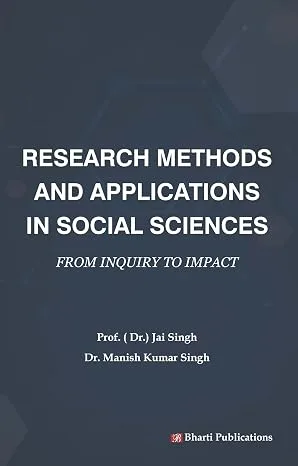
Download Cover Image
Do you want to download the full cover image for Research Methods and Applications in Social Sciences: From Inquiry to Impact?