
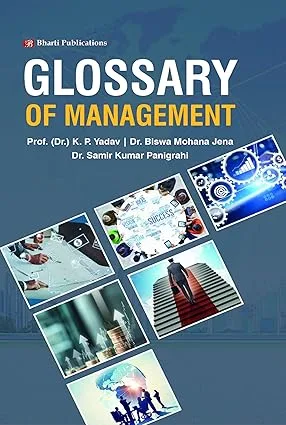
Glossary of Management
Prof. (Dr.) K. P. Yadav, Dr. Biswa Mohane Jena
Paperback
• 330 Pages
• inr 499.00
• English
• 9789349566064
No ratings yet
| Publisher | Bharti Publications |
|---|---|
| Brand/Group | Bharti Publications |
| ISBN13 | 9789349566064 |
| ASIN/SKU | 9349566060 |
| Book Format | Paperback |
| Language | English |
| Pages | 330 |
| List Price | inr 499.00 |
| Publishing Date | 15/10/2025 |
| Dimensions | 14 x 1.8 x 21.5 |
| Weight | 450 |
| Book Code | BD00069493 |
Buy this Book
Amazon Stores
Ebook Stores
Other Stores
Discover Glossary of Management by Prof. (Dr.) K. P. Yadav. This book is published by Bharti Publications in Paperback format, ISBN 9789349566064, ASIN 9349566060, under Management.
Book Description
The book“Glossary Management”authored by Prof. (Dr.) K. P. Yadav, Dr. Biswamohan Jena, and Dr. Samir Kumar Panigrahi serves as a comprehensive reference guide encompassing the core concepts of Commerce and Management. Designed with academic clarity and professional relevance, this book provides precise definitions, explanations, and interpretations of essential terms used across various disciplines such as accounting, finance, marketing, human resource management, Business Statistics, and business administration.
Author Biography
Prof. (Dr.) K. P. Yadav, a distinguished academician and visionary leader, currently serves as Vice Chancellor of MATS University, Raipur (NAAC A+). He is also the Hon’ble President of India’s Nominee for IIIT Tiruchirappalli and Nagaland Central University, and Governor’s Nominee to Mahatma Gandhi University of Horticulture & Forestry and Atal Bihari Bajpai University, Chhattisgarh.
Dr. Biswa Mohana Jena is Former Head, Department of Commerce in Netaji Subhas Chandra Bose (A Govt Lead) College, Sambalpur. He has teaching experience of 15 years. His keen areas of interest are Auditing, Financial Accounting, Cost Accounting, Management Accounting, Business Statistics, Financial Management, Corporate Accounting, Entrepreneurship, Business Law etc.
Dr. Samir Kumar Panigrahi holds B. Com (Accounting Hons.), M. Com (Financial Management), MBA (Finance & Marketing), M.Phil. in Commerce, Ph.D. (Commerce & Management), Post-Doctoral Fellowship (Management), LL. B, LL.M., and Ph.D. (Law) Continuing.
Dr. Biswa Mohana Jena is Former Head, Department of Commerce in Netaji Subhas Chandra Bose (A Govt Lead) College, Sambalpur. He has teaching experience of 15 years. His keen areas of interest are Auditing, Financial Accounting, Cost Accounting, Management Accounting, Business Statistics, Financial Management, Corporate Accounting, Entrepreneurship, Business Law etc.
Dr. Samir Kumar Panigrahi holds B. Com (Accounting Hons.), M. Com (Financial Management), MBA (Finance & Marketing), M.Phil. in Commerce, Ph.D. (Commerce & Management), Post-Doctoral Fellowship (Management), LL. B, LL.M., and Ph.D. (Law) Continuing.
Editorial Reviews
Editorial Reviews will be added soon…
Book Summary
Glossary Management, authored by Prof. (Dr.) K. P. Yadav, Dr. Biswamohan Jena, and Dr. Samir Kumar Panigrahi, is a comprehensive and authoritative reference guide that brings together the essential terminology of Commerce and Management in a clear, systematic, and accessible format. In an increasingly dynamic business environment, where students, educators, researchers, and professionals encounter an ever-expanding range of technical concepts, a reliable and well-organized glossary becomes an indispensable learning resource. This book has been developed to meet that need by providing accurate definitions, concise explanations, and contextual interpretations of the fundamental terms that form the foundation of business education and practice.
The study of Commerce and Management encompasses numerous specialized disciplines, each with its own vocabulary, theoretical frameworks, and professional applications. Whether one is studying accounting principles, analysing financial statements, understanding marketing strategies, managing human resources, interpreting business statistics, or exploring organizational behaviour, familiarity with the correct terminology is essential for academic success and professional competence. Recognizing this requirement, the authors have compiled an extensive collection of key concepts that enables readers to develop a strong conceptual understanding while enhancing their communication and analytical skills.
One of the distinguishing features of Glossary Management is its interdisciplinary coverage. The book draws terminology from a wide spectrum of subjects within Commerce and Management, making it a valuable companion for learners at various stages of their academic and professional journeys. It includes carefully selected terms from accounting, financial management, banking, economics, marketing management, human resource management, business statistics, organizational behaviour, entrepreneurship, business law, taxation, production and operations management, strategic management, business administration, and other related fields. By integrating concepts from multiple disciplines into a single reference volume, the book provides readers with a holistic understanding of the language of business.
Each entry has been presented with precision and simplicity, ensuring that complex concepts are explained in language that is easy to understand without compromising academic accuracy. The definitions are supported by concise explanations that clarify the meaning and practical significance of each term, enabling readers not only to memorize terminology but also to appreciate its relevance in real-world business situations. This approach makes the book particularly useful for students preparing for examinations, competitive tests, classroom discussions, presentations, and project work.
The book has been designed with the needs of a diverse readership in mind. Undergraduate and postgraduate students will find it an excellent study companion for strengthening conceptual clarity across different management subjects. Researchers and scholars can use it as a quick reference while reviewing literature, preparing academic papers, or conducting interdisciplinary research. Faculty members may rely on it to simplify classroom teaching and enhance students’ understanding of technical terminology. Professionals working in business organizations, financial institutions, government agencies, and corporate sectors will also benefit from its concise explanations, which support effective communication and informed decision-making in the workplace.
A significant strength of the book lies in its emphasis on conceptual accuracy and consistency. In disciplines such as Commerce and Management, the correct interpretation of technical terms is essential because even minor misunderstandings can lead to incorrect analysis or inappropriate business decisions. By presenting standardized definitions and widely accepted interpretations, the authors help readers build a solid conceptual foundation that supports both academic learning and professional application.
Beyond serving as a dictionary of business terms, Glossary Management functions as a valuable educational resource that promotes continuous learning. The carefully organized entries encourage readers to explore relationships among concepts across different functional areas of management, fostering interdisciplinary thinking and integrated understanding. As business education increasingly emphasizes analytical reasoning, strategic decision-making, and practical problem-solving, the ability to comprehend and correctly apply technical terminology becomes a critical skill. This glossary contributes significantly to that objective by making business language accessible and meaningful.
Another noteworthy aspect of the book is its practical orientation. Many of the included terms are directly applicable to contemporary business environments shaped by globalization, digital transformation, technological innovation, entrepreneurship, financial inclusion, and evolving management practices. Readers are therefore equipped not only with theoretical knowledge but also with terminology that reflects current developments in commerce and business management. This contemporary relevance enhances the usefulness of the book for both academic study and professional practice.
The collaborative expertise of the three authors further strengthens the quality and reliability of the work. Drawing upon their extensive academic experience, research contributions, and engagement with management education, the authors have carefully selected and organized the terminology to reflect the changing needs of learners and practitioners. Their combined knowledge ensures that the glossary maintains academic rigour while remaining practical, reader-friendly, and relevant to modern business education.
The systematic organization of the glossary allows users to locate information quickly and efficiently, making it an ideal desk reference for everyday consultation. Whether readers seek clarification of a single concept or wish to reinforce their understanding of an entire subject area, the book provides a convenient and dependable source of information. Its clear structure and accessible presentation make it equally suitable for self-learning, classroom instruction, library reference, and professional use.
Overall, Glossary Management is much more than a compilation of business terminology. It is a comprehensive knowledge resource that supports learning, teaching, research, and professional development across the broad spectrum of Commerce and Management. By presenting essential concepts with clarity, precision, and contextual relevance, the book empowers readers to communicate effectively, strengthen conceptual understanding, and confidently engage with the language of business. As a practical reference guide and academic companion, it will prove invaluable for students, educators, researchers, and professionals seeking a reliable foundation in the terminology that underpins contemporary commerce and management studies.
The study of Commerce and Management encompasses numerous specialized disciplines, each with its own vocabulary, theoretical frameworks, and professional applications. Whether one is studying accounting principles, analysing financial statements, understanding marketing strategies, managing human resources, interpreting business statistics, or exploring organizational behaviour, familiarity with the correct terminology is essential for academic success and professional competence. Recognizing this requirement, the authors have compiled an extensive collection of key concepts that enables readers to develop a strong conceptual understanding while enhancing their communication and analytical skills.
One of the distinguishing features of Glossary Management is its interdisciplinary coverage. The book draws terminology from a wide spectrum of subjects within Commerce and Management, making it a valuable companion for learners at various stages of their academic and professional journeys. It includes carefully selected terms from accounting, financial management, banking, economics, marketing management, human resource management, business statistics, organizational behaviour, entrepreneurship, business law, taxation, production and operations management, strategic management, business administration, and other related fields. By integrating concepts from multiple disciplines into a single reference volume, the book provides readers with a holistic understanding of the language of business.
Each entry has been presented with precision and simplicity, ensuring that complex concepts are explained in language that is easy to understand without compromising academic accuracy. The definitions are supported by concise explanations that clarify the meaning and practical significance of each term, enabling readers not only to memorize terminology but also to appreciate its relevance in real-world business situations. This approach makes the book particularly useful for students preparing for examinations, competitive tests, classroom discussions, presentations, and project work.
The book has been designed with the needs of a diverse readership in mind. Undergraduate and postgraduate students will find it an excellent study companion for strengthening conceptual clarity across different management subjects. Researchers and scholars can use it as a quick reference while reviewing literature, preparing academic papers, or conducting interdisciplinary research. Faculty members may rely on it to simplify classroom teaching and enhance students’ understanding of technical terminology. Professionals working in business organizations, financial institutions, government agencies, and corporate sectors will also benefit from its concise explanations, which support effective communication and informed decision-making in the workplace.
A significant strength of the book lies in its emphasis on conceptual accuracy and consistency. In disciplines such as Commerce and Management, the correct interpretation of technical terms is essential because even minor misunderstandings can lead to incorrect analysis or inappropriate business decisions. By presenting standardized definitions and widely accepted interpretations, the authors help readers build a solid conceptual foundation that supports both academic learning and professional application.
Beyond serving as a dictionary of business terms, Glossary Management functions as a valuable educational resource that promotes continuous learning. The carefully organized entries encourage readers to explore relationships among concepts across different functional areas of management, fostering interdisciplinary thinking and integrated understanding. As business education increasingly emphasizes analytical reasoning, strategic decision-making, and practical problem-solving, the ability to comprehend and correctly apply technical terminology becomes a critical skill. This glossary contributes significantly to that objective by making business language accessible and meaningful.
Another noteworthy aspect of the book is its practical orientation. Many of the included terms are directly applicable to contemporary business environments shaped by globalization, digital transformation, technological innovation, entrepreneurship, financial inclusion, and evolving management practices. Readers are therefore equipped not only with theoretical knowledge but also with terminology that reflects current developments in commerce and business management. This contemporary relevance enhances the usefulness of the book for both academic study and professional practice.
The collaborative expertise of the three authors further strengthens the quality and reliability of the work. Drawing upon their extensive academic experience, research contributions, and engagement with management education, the authors have carefully selected and organized the terminology to reflect the changing needs of learners and practitioners. Their combined knowledge ensures that the glossary maintains academic rigour while remaining practical, reader-friendly, and relevant to modern business education.
The systematic organization of the glossary allows users to locate information quickly and efficiently, making it an ideal desk reference for everyday consultation. Whether readers seek clarification of a single concept or wish to reinforce their understanding of an entire subject area, the book provides a convenient and dependable source of information. Its clear structure and accessible presentation make it equally suitable for self-learning, classroom instruction, library reference, and professional use.
Overall, Glossary Management is much more than a compilation of business terminology. It is a comprehensive knowledge resource that supports learning, teaching, research, and professional development across the broad spectrum of Commerce and Management. By presenting essential concepts with clarity, precision, and contextual relevance, the book empowers readers to communicate effectively, strengthen conceptual understanding, and confidently engage with the language of business. As a practical reference guide and academic companion, it will prove invaluable for students, educators, researchers, and professionals seeking a reliable foundation in the terminology that underpins contemporary commerce and management studies.
Sample Chapters
Sample Chapters will be added soon…
Reader Reviews
No reviews yet.
Glossary of Management
Download Cover Image
Do you want to download the full cover image for Glossary of Management?