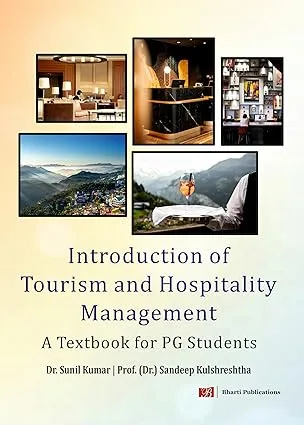
Introduction of Tourism and Hospitality Management: A Textbook for PG Students
Dr. Sunil Kumar, Prof. (Dr.) Sandeep Kulshreshtha
Paperback
• 204 Pages
• inr 495.00
• English
• 9789349566200
No ratings yet
| Publisher | Bharti Publications |
|---|---|
| Brand/Group | Bharti Publications |
| ISBN13 | 9789349566200 |
| ASIN/SKU | 9349566206 |
| Book Format | Paperback |
| Language | English |
| Pages | 204 |
| List Price | inr 495.00 |
| Publishing Date | 01/05/2025 |
| Dimensions | 18.5 x 2.5 x 24 |
| Weight | 350 |
| Book Code | BD00069501 |
Buy this Book
Amazon Stores
Ebook Stores
Other Stores
Discover Introduction of Tourism and Hospitality Management: A Textbook for PG Students by Dr. Sunil Kumar. This book is published by Bharti Publications in Paperback format, ISBN 9789349566200, ASIN 9349566206.
Book Description
This textbook, designed for students, professionals, and enthusiasts of tourism, aims to provide a comprehensive understanding of tourism’s multifaceted nature. It serves as a foundational guide for exploring the theoretical frameworks, practical applications, and evolving trends in the tourism and hospitality sectors.
Purpose and Objectives
The primary objective of this textbook is to equip readers with a deep understanding of the core concepts, historical developments, and practical structures that define tourism and hospitality. The book offers insights into the complex interplay of tourism’s components, its economic, sociocultural, and ecological impacts, and its role in shaping global and local economies.
Features
Each chapter is designed with the following components to enhance understanding:-
★ Case Studies and Applications: Practical insights and
examples to connect theory with practice.
★ Key Terms: Definitions of critical concepts for quick reference.
★ Review Questions: Thought-provoking questions to assess
comprehension and encourage critical thinking.
★ Learning Activities: Practical exercises to reinforce learning
and encourage exploration of real-world scenarios.
Purpose and Objectives
The primary objective of this textbook is to equip readers with a deep understanding of the core concepts, historical developments, and practical structures that define tourism and hospitality. The book offers insights into the complex interplay of tourism’s components, its economic, sociocultural, and ecological impacts, and its role in shaping global and local economies.
Features
Each chapter is designed with the following components to enhance understanding:-
★ Case Studies and Applications: Practical insights and
examples to connect theory with practice.
★ Key Terms: Definitions of critical concepts for quick reference.
★ Review Questions: Thought-provoking questions to assess
comprehension and encourage critical thinking.
★ Learning Activities: Practical exercises to reinforce learning
and encourage exploration of real-world scenarios.
Author Biography
Dr Sunil Kumar is presently working as Assistant Professor at Mizoram University Aizawl. He has past work experience in Institute of Hotel Management Raipur, Indian Culinary Institute, NOIDA, IHM Rohtak, IHTM MDU Rohtak, Dav Girls College Yamunanagar, IHM Gwalior and IHM Bathinda. He was an alumni of IHM Gwalior in 2010 and IHTM MDU Rohtak in 2014. He has 14 years teaching and industry experience in India. He is a member of the Board of Studies in ITM University Raipur and other universities. In his credit 29 research papers presented in National and International seminars and conferences. He is a multi-faceted personality with a keen interest in cooking, baking and reading. He published 10 research papers in National and International Journals. He published three books and four patents. His research area is Culinary Heritage, Food Tourism, Digital Marketing and Eating Habits. He has published 10 research papers in National and International Journals and 05 Patents in India. He has also written another 08 Textbook books.
Prof. (Dr.) Sandeep Kulshreshtha is currently Director at Centre for Ecological, Adventure, Health and Cultural Tourism Central University Himachal Pradesh, Dharamshala India. He was Former Director of IITTM (From 2014-19, All 7 Centres of IITTM Gwalior, Bhubaneswar, Noida, Nellore, Goa, Shillong, Bodh Gaya). Prof. Kulshreshtha is President, Tourism and Hospitality Educators and Research Association of Asia (THERAA) and Sr. Vice President & Advisor – Indian Tourism and Hospitality Congress (ITHC). He was Ex Chairman of All India Board of Hospitality Management and Catering Technology, All India Council of Technical Education (Ministry of Education Govt. of India). Prof. Kulshreshtha visted 58 Countries on Academic Assignments like Switzerland, England, China, Greece, Italy, Belgium, The Netherlands, Singapore, Japan etc. He delivered keynote speeches/expert lectures at various national and international conferences and universities. Prof. Kulshreshtha have been published five books and more than 55 papers on different themes related to Management and Tourism. Ninteen research scholars have completed Ph.D. under his guidance. He received Citation award by Union Minister of Water Resource, Shri Sawarmal Jat on 14th Feb. 2015 at University of Rajasthan, Jaipur for promotion of Tourism education and Training in India.
Prof. (Dr.) Sandeep Kulshreshtha is currently Director at Centre for Ecological, Adventure, Health and Cultural Tourism Central University Himachal Pradesh, Dharamshala India. He was Former Director of IITTM (From 2014-19, All 7 Centres of IITTM Gwalior, Bhubaneswar, Noida, Nellore, Goa, Shillong, Bodh Gaya). Prof. Kulshreshtha is President, Tourism and Hospitality Educators and Research Association of Asia (THERAA) and Sr. Vice President & Advisor – Indian Tourism and Hospitality Congress (ITHC). He was Ex Chairman of All India Board of Hospitality Management and Catering Technology, All India Council of Technical Education (Ministry of Education Govt. of India). Prof. Kulshreshtha visted 58 Countries on Academic Assignments like Switzerland, England, China, Greece, Italy, Belgium, The Netherlands, Singapore, Japan etc. He delivered keynote speeches/expert lectures at various national and international conferences and universities. Prof. Kulshreshtha have been published five books and more than 55 papers on different themes related to Management and Tourism. Ninteen research scholars have completed Ph.D. under his guidance. He received Citation award by Union Minister of Water Resource, Shri Sawarmal Jat on 14th Feb. 2015 at University of Rajasthan, Jaipur for promotion of Tourism education and Training in India.
Editorial Reviews
Editorial Reviews will be added soon…
Book Summary
This textbook has been thoughtfully developed to provide students, educators, researchers, professionals, and enthusiasts with a comprehensive understanding of the dynamic and multidisciplinary field of tourism and hospitality. As one of the world's fastest-growing industries, tourism plays a vital role in economic development, cultural exchange, environmental conservation, and international cooperation. Understanding its complex nature requires not only theoretical knowledge but also practical insights into the diverse sectors that contribute to the tourism experience. This book serves as a foundational guide that bridges academic concepts with real-world applications, enabling readers to appreciate both the principles and practices that shape the modern tourism and hospitality industry.
The primary objective of the book is to equip readers with a thorough understanding of the core concepts, historical evolution, organizational structures, and emerging trends that define tourism and hospitality. It introduces tourism as a multifaceted phenomenon involving the movement of people, the provision of services, destination management, cultural interactions, and sustainable development. By examining tourism from economic, social, cultural, environmental, and managerial perspectives, the book enables readers to develop a holistic appreciation of the industry's significance in both global and local contexts.
The textbook begins by exploring the foundations of tourism, introducing readers to the meaning, nature, scope, and importance of tourism as an academic discipline and an economic activity. It traces the historical development of travel and tourism, highlighting how technological advancements, globalization, improved transportation, and changing consumer preferences have transformed tourism into a major contributor to national and international economies. The discussion establishes a strong conceptual framework that prepares readers for more advanced topics presented in subsequent chapters.
A significant focus of the book is the structure and components of the tourism industry. Readers gain insights into the interconnected roles of transportation, accommodation, travel agencies, tour operators, destination management organizations, hospitality enterprises, government bodies, and supporting service providers. The book explains how these sectors work together to create seamless travel experiences while contributing to employment generation, regional development, and economic growth. Through this integrated approach, readers develop an understanding of tourism as a collaborative system involving multiple stakeholders.
The textbook also examines the economic, socio-cultural, and environmental dimensions of tourism. It discusses tourism's contribution to income generation, foreign exchange earnings, entrepreneurship, infrastructure development, and employment creation. At the same time, it critically analyses the social and cultural impacts of tourism, including cultural exchange, heritage preservation, community participation, and the challenges associated with commercialization and cultural change. Environmental issues such as sustainable tourism, ecotourism, responsible destination management, conservation of natural resources, and climate change are also explored, encouraging readers to appreciate the importance of balancing economic growth with environmental stewardship and social responsibility.
Recognizing the rapidly evolving nature of the tourism sector, the book incorporates discussions on contemporary trends and emerging developments that are reshaping the industry. Topics such as digital tourism, online travel platforms, smart destinations, sustainable tourism practices, experiential travel, wellness tourism, medical tourism, rural tourism, heritage tourism, adventure tourism, and responsible travel are introduced to help readers understand the changing preferences of modern travellers. These contemporary perspectives prepare students to engage with current industry challenges and opportunities while developing innovative approaches to tourism management.
One of the distinguishing strengths of this textbook is its strong emphasis on practical learning. Every chapter has been carefully designed to promote active engagement and facilitate the application of theoretical knowledge to real-life situations. Case studies and practical applications present authentic examples from the tourism and hospitality industry, enabling readers to analyse challenges, evaluate strategies, and understand how theoretical concepts operate in professional settings. These practical illustrations strengthen analytical and decision-making skills while making learning more meaningful and relevant.
To reinforce conceptual understanding, each chapter includes a comprehensive list of key terms, providing concise definitions of important concepts and terminology commonly used in tourism and hospitality. These definitions serve as quick reference tools that help readers build a strong academic vocabulary and improve their understanding of subject-specific language, making the book particularly useful for examination preparation and professional communication.
The inclusion of review questions at the end of each chapter encourages readers to assess their understanding, reflect critically on the topics studied, and consolidate their learning. These carefully designed questions promote analytical thinking rather than rote memorization, helping students develop the ability to interpret concepts, evaluate issues, and apply knowledge in academic and professional contexts.
In addition, learning activities provide readers with opportunities to engage in practical exercises, discussions, field observations, and project-based tasks that connect classroom learning with real-world tourism environments. These activities encourage independent exploration, collaborative learning, and experiential understanding, allowing students to develop practical skills alongside theoretical knowledge. Such an interactive approach makes the learning process more engaging and prepares readers for future careers in tourism and hospitality.
The book adopts a learner-centred approach, presenting complex concepts in clear, accessible language supported by relevant examples, illustrations, and contemporary case studies. This pedagogical style ensures that the content remains suitable for undergraduate and postgraduate students while also serving as a valuable reference for tourism professionals, educators, entrepreneurs, policymakers, and anyone interested in understanding the evolving tourism landscape.
Overall, this textbook provides a balanced blend of academic rigour and practical relevance, making it an indispensable resource for the study of tourism and hospitality. By integrating foundational theories, industry practices, contemporary trends, and experiential learning tools, it prepares readers to understand the diverse dimensions of tourism and contribute effectively to its sustainable development. Whether used as a classroom textbook, a reference guide, or a professional resource, the book empowers learners to develop the knowledge, analytical skills, and practical competencies required to succeed in the ever-changing world of tourism and hospitality while appreciating its profound influence on economies, societies, cultures, and the environment.
The primary objective of the book is to equip readers with a thorough understanding of the core concepts, historical evolution, organizational structures, and emerging trends that define tourism and hospitality. It introduces tourism as a multifaceted phenomenon involving the movement of people, the provision of services, destination management, cultural interactions, and sustainable development. By examining tourism from economic, social, cultural, environmental, and managerial perspectives, the book enables readers to develop a holistic appreciation of the industry's significance in both global and local contexts.
The textbook begins by exploring the foundations of tourism, introducing readers to the meaning, nature, scope, and importance of tourism as an academic discipline and an economic activity. It traces the historical development of travel and tourism, highlighting how technological advancements, globalization, improved transportation, and changing consumer preferences have transformed tourism into a major contributor to national and international economies. The discussion establishes a strong conceptual framework that prepares readers for more advanced topics presented in subsequent chapters.
A significant focus of the book is the structure and components of the tourism industry. Readers gain insights into the interconnected roles of transportation, accommodation, travel agencies, tour operators, destination management organizations, hospitality enterprises, government bodies, and supporting service providers. The book explains how these sectors work together to create seamless travel experiences while contributing to employment generation, regional development, and economic growth. Through this integrated approach, readers develop an understanding of tourism as a collaborative system involving multiple stakeholders.
The textbook also examines the economic, socio-cultural, and environmental dimensions of tourism. It discusses tourism's contribution to income generation, foreign exchange earnings, entrepreneurship, infrastructure development, and employment creation. At the same time, it critically analyses the social and cultural impacts of tourism, including cultural exchange, heritage preservation, community participation, and the challenges associated with commercialization and cultural change. Environmental issues such as sustainable tourism, ecotourism, responsible destination management, conservation of natural resources, and climate change are also explored, encouraging readers to appreciate the importance of balancing economic growth with environmental stewardship and social responsibility.
Recognizing the rapidly evolving nature of the tourism sector, the book incorporates discussions on contemporary trends and emerging developments that are reshaping the industry. Topics such as digital tourism, online travel platforms, smart destinations, sustainable tourism practices, experiential travel, wellness tourism, medical tourism, rural tourism, heritage tourism, adventure tourism, and responsible travel are introduced to help readers understand the changing preferences of modern travellers. These contemporary perspectives prepare students to engage with current industry challenges and opportunities while developing innovative approaches to tourism management.
One of the distinguishing strengths of this textbook is its strong emphasis on practical learning. Every chapter has been carefully designed to promote active engagement and facilitate the application of theoretical knowledge to real-life situations. Case studies and practical applications present authentic examples from the tourism and hospitality industry, enabling readers to analyse challenges, evaluate strategies, and understand how theoretical concepts operate in professional settings. These practical illustrations strengthen analytical and decision-making skills while making learning more meaningful and relevant.
To reinforce conceptual understanding, each chapter includes a comprehensive list of key terms, providing concise definitions of important concepts and terminology commonly used in tourism and hospitality. These definitions serve as quick reference tools that help readers build a strong academic vocabulary and improve their understanding of subject-specific language, making the book particularly useful for examination preparation and professional communication.
The inclusion of review questions at the end of each chapter encourages readers to assess their understanding, reflect critically on the topics studied, and consolidate their learning. These carefully designed questions promote analytical thinking rather than rote memorization, helping students develop the ability to interpret concepts, evaluate issues, and apply knowledge in academic and professional contexts.
In addition, learning activities provide readers with opportunities to engage in practical exercises, discussions, field observations, and project-based tasks that connect classroom learning with real-world tourism environments. These activities encourage independent exploration, collaborative learning, and experiential understanding, allowing students to develop practical skills alongside theoretical knowledge. Such an interactive approach makes the learning process more engaging and prepares readers for future careers in tourism and hospitality.
The book adopts a learner-centred approach, presenting complex concepts in clear, accessible language supported by relevant examples, illustrations, and contemporary case studies. This pedagogical style ensures that the content remains suitable for undergraduate and postgraduate students while also serving as a valuable reference for tourism professionals, educators, entrepreneurs, policymakers, and anyone interested in understanding the evolving tourism landscape.
Overall, this textbook provides a balanced blend of academic rigour and practical relevance, making it an indispensable resource for the study of tourism and hospitality. By integrating foundational theories, industry practices, contemporary trends, and experiential learning tools, it prepares readers to understand the diverse dimensions of tourism and contribute effectively to its sustainable development. Whether used as a classroom textbook, a reference guide, or a professional resource, the book empowers learners to develop the knowledge, analytical skills, and practical competencies required to succeed in the ever-changing world of tourism and hospitality while appreciating its profound influence on economies, societies, cultures, and the environment.
Sample Chapters
Sample Chapters will be added soon…
Reader Reviews
No reviews yet.
Introduction of Tourism and Hospitality Management: A Textbook for PG Students
Download Cover Image
Do you want to download the full cover image for Introduction of Tourism and Hospitality Management: A Textbook for PG Students?