
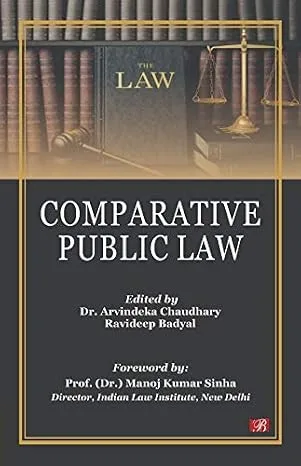
COMPARATIVE PUBLIC LAW
Dr. Arvindeka Chaudhary, Ravideep Badyal
Hardcover
• 283 Pages
• inr 885.00
• English
• 9789389657340
No ratings yet
| Publisher | Bharti Publications |
|---|---|
| Brand/Group | Bharti Publications |
| ISBN13 | 9789389657340 |
| ASIN/SKU | 9389657342 |
| Book Format | Hardcover |
| Language | English |
| Pages | 283 |
| List Price | inr 885.00 |
| Publishing Date | 01/01/2020 |
| Dimensions | 15 x 3 x 22 |
| Weight | 450 |
| Book Code | BD00069514 |
Buy this Book
Amazon Stores
Ebook Stores
Other Stores
Discover COMPARATIVE PUBLIC LAW by Dr. Arvindeka Chaudhary. This book is published by Bharti Publications in Hardcover format, ISBN 9789389657340, ASIN 9389657342, under Law Practice, law.
Book Description
Public Law is defined as the law of relations between the individuals and the state. In this context comparative public law can be defined as that branch of law that focuses on the comparison of individual-state relations of different countries with the individual-state relations of the Indian state. The importance of comparative law has seen a tremendous increment in the present age of internationalism, democratization and economic globalization. India is one such country that is still in its growing arena and its legal system has changed manifolds since the time it has gained consciousness towards the improvisation of laws on a more individualistic approach. The editors and the authors of the book have made efforts to discuss all those issues that are recurrent to the Indian legal system in comparison to other international legal systems. Subjects such as constitutional amendments, federal governance, rule of law, right to know, right to life and personal liberty and so on have been discussed in this book. This book provides with an insight into the growth of the Indian legal system from its primitive stages till now and also helps the reader to analyze the current Indian legal system from a comparative approach as adopted by the authors.
Author Biography
Dr. Arvindeka Chaudhary has been always passionate about discipline of Law: Following the fervour, she pursued her LL.M. and LL.B. from Guru Nanak Dev University, Amritsar. With devotion and dedication, she completed her Ph.D from the same university She is a self-determined learner and a strong believer of altruism. dis far, she has penned down book titled "Admissibility of Scientific Evidence". To her name there are various publications including in international and national journals. Besides, she has contributed her chapters in books "The Right to Information Act, 2005 A Contemporary Tool of Data Collection and 'Protection of Intellectual Research from Plagiarism in the Era of Copyright Lo She is presently working as Assistant Professor at Department of Laves, Guru Nanak Des University, Amritsar, Punjab.
Ravideep Badyal is a keen disciplinarian of Constitutional Lase and constantly working towards the contribution, and enrichment in this field. He is presently teaching as Assistant Professor of Lave Department of Laws, Guru Nanak Dev University Amritsan He did his LLM. from Indian Law Institute University, Delhi and is pursuing Ph.D. from Guru Nanak Dev Universing Amritsar, Punjab, He has authored various research articles that are published in various reputed Journals research based and directed on the subject of Constitutional Law.
Ravideep Badyal is a keen disciplinarian of Constitutional Lase and constantly working towards the contribution, and enrichment in this field. He is presently teaching as Assistant Professor of Lave Department of Laws, Guru Nanak Dev University Amritsan He did his LLM. from Indian Law Institute University, Delhi and is pursuing Ph.D. from Guru Nanak Dev Universing Amritsar, Punjab, He has authored various research articles that are published in various reputed Journals research based and directed on the subject of Constitutional Law.
Editorial Reviews
Editorial Reviews will be added soon…
Book Summary
Comparative Public Law offers a comprehensive and analytical exploration of the evolving relationship between the individual and the State through the lens of comparative legal studies. Public law, broadly understood as the body of law governing the relationship between citizens and governmental institutions, forms the foundation of constitutional governance, the protection of fundamental rights, and the exercise of public authority. This volume examines how different legal systems address these relationships and compares their approaches with the constitutional and legal framework of India. By integrating comparative perspectives with contemporary legal developments, the book provides readers with a deeper understanding of the strengths, challenges, and future direction of the Indian public law system.
In an era characterized by globalization, democratization, technological advancement, and increasing international cooperation, comparative legal analysis has become an indispensable tool for legal scholarship and policymaking. Nations today frequently draw upon constitutional experiences, judicial innovations, and legislative practices from other jurisdictions while addressing complex legal and governance challenges. Recognizing this growing significance, the book demonstrates how comparative public law enables a better understanding of constitutional values, institutional design, human rights protection, and democratic governance by examining similarities and differences among legal systems across the world.
The volume begins by introducing readers to the conceptual foundations of public law and comparative legal methodology. It explains the significance of studying legal systems beyond national boundaries and highlights how comparative analysis contributes to legal reform, judicial interpretation, constitutional development, and policy innovation. By placing the Indian legal system within a broader international context, the book encourages readers to appreciate the dynamic nature of law and its continuous evolution in response to changing social, political, and economic realities.
A central theme of the book is the development of the Indian legal system and its interaction with constitutional principles adopted by other democratic nations. India has witnessed remarkable constitutional and legal transformation since independence, progressively expanding the scope of individual rights, strengthening democratic institutions, and refining mechanisms of governance. The contributors trace this evolution from its foundational stages to the contemporary legal framework, illustrating how constitutional jurisprudence has adapted to meet the changing aspirations of society while maintaining the fundamental values of justice, liberty, equality, and the rule of law.
The book provides an in-depth examination of several important areas of public law through a comparative perspective. One of its major areas of discussion is constitutional amendments, analysing how constitutional flexibility and stability are balanced in India and other jurisdictions. Readers gain insights into amendment procedures, constitutional evolution, judicial review, and the role of constitutional courts in safeguarding democratic values while accommodating social and political change.
Another significant focus is federal governance, where the contributors compare the distribution of legislative, executive, and financial powers among different federal systems. The book explores the functioning of Centre–State relations in India alongside comparable constitutional arrangements in other countries, enabling readers to understand diverse models of cooperative federalism, decentralization, and constitutional governance. These discussions highlight both the distinctive characteristics of the Indian federal structure and the broader principles that guide federal democracies worldwide.
The principle of the Rule of Law forms another cornerstone of the volume. The contributors examine its historical development, constitutional significance, and practical application in ensuring accountability, limiting arbitrary exercise of power, and protecting individual rights. Through comparative analysis, readers are introduced to varying interpretations and institutional safeguards adopted across different legal systems, illustrating how the rule of law remains fundamental to constitutional democracy and good governance.
The book also offers comprehensive discussions on fundamental rights, particularly the Right to Life and Personal Liberty and the Right to Know, both of which have undergone significant judicial expansion in India. Comparative analysis enables readers to understand how courts in different jurisdictions have interpreted similar rights, balancing individual freedoms with public interests, national security, administrative efficiency, and societal welfare. The examination of these rights demonstrates the increasing influence of comparative constitutional jurisprudence on judicial reasoning and legal development.
Beyond these themes, the contributors address several other contemporary issues affecting public law, including judicial activism, constitutional interpretation, human rights protection, administrative accountability, access to justice, transparency, and democratic governance. These discussions reflect the dynamic and interdisciplinary character of public law while emphasizing its relevance in addressing emerging legal and societal challenges in an interconnected world.
One of the distinguishing strengths of the book is its comparative methodology, which encourages readers to critically evaluate legal institutions rather than merely describe them. By analysing multiple constitutional systems alongside Indian law, the contributors enable readers to identify best practices, appreciate diverse legal traditions, and understand how constitutional principles operate within different political, cultural, and historical contexts. This approach fosters analytical thinking and promotes a broader understanding of constitutional governance beyond national boundaries.
The collaborative contributions of experienced scholars and legal experts enrich the volume by presenting diverse perspectives on contemporary public law issues. Their interdisciplinary analyses combine constitutional theory, judicial interpretation, comparative legal research, and policy considerations, making the book academically rigorous while remaining accessible to readers from different backgrounds. Practical examples, judicial developments, and comparative case analyses further enhance the relevance and readability of the text.
Written in clear and systematic language, the book is intended for a wide audience, including undergraduate and postgraduate law students, researchers, academicians, legal practitioners, judicial officers, policymakers, civil servants, and anyone interested in constitutional law and comparative legal studies. It also serves as a valuable reference for scholars seeking to understand the evolution of the Indian legal system within the broader framework of international constitutional developments.
Overall, Comparative Public Law provides a thoughtful and comprehensive examination of the relationship between individuals and the State through the comparative study of constitutional and public law systems. By tracing the historical evolution of Indian public law, analysing contemporary constitutional issues, and comparing them with international legal practices, the book offers readers a deeper appreciation of the principles that underpin democratic governance and the protection of individual rights. It stands as an important contribution to legal scholarship, encouraging critical reflection, comparative inquiry, and informed dialogue on the continuing development of constitutional law in India and across the world.
In an era characterized by globalization, democratization, technological advancement, and increasing international cooperation, comparative legal analysis has become an indispensable tool for legal scholarship and policymaking. Nations today frequently draw upon constitutional experiences, judicial innovations, and legislative practices from other jurisdictions while addressing complex legal and governance challenges. Recognizing this growing significance, the book demonstrates how comparative public law enables a better understanding of constitutional values, institutional design, human rights protection, and democratic governance by examining similarities and differences among legal systems across the world.
The volume begins by introducing readers to the conceptual foundations of public law and comparative legal methodology. It explains the significance of studying legal systems beyond national boundaries and highlights how comparative analysis contributes to legal reform, judicial interpretation, constitutional development, and policy innovation. By placing the Indian legal system within a broader international context, the book encourages readers to appreciate the dynamic nature of law and its continuous evolution in response to changing social, political, and economic realities.
A central theme of the book is the development of the Indian legal system and its interaction with constitutional principles adopted by other democratic nations. India has witnessed remarkable constitutional and legal transformation since independence, progressively expanding the scope of individual rights, strengthening democratic institutions, and refining mechanisms of governance. The contributors trace this evolution from its foundational stages to the contemporary legal framework, illustrating how constitutional jurisprudence has adapted to meet the changing aspirations of society while maintaining the fundamental values of justice, liberty, equality, and the rule of law.
The book provides an in-depth examination of several important areas of public law through a comparative perspective. One of its major areas of discussion is constitutional amendments, analysing how constitutional flexibility and stability are balanced in India and other jurisdictions. Readers gain insights into amendment procedures, constitutional evolution, judicial review, and the role of constitutional courts in safeguarding democratic values while accommodating social and political change.
Another significant focus is federal governance, where the contributors compare the distribution of legislative, executive, and financial powers among different federal systems. The book explores the functioning of Centre–State relations in India alongside comparable constitutional arrangements in other countries, enabling readers to understand diverse models of cooperative federalism, decentralization, and constitutional governance. These discussions highlight both the distinctive characteristics of the Indian federal structure and the broader principles that guide federal democracies worldwide.
The principle of the Rule of Law forms another cornerstone of the volume. The contributors examine its historical development, constitutional significance, and practical application in ensuring accountability, limiting arbitrary exercise of power, and protecting individual rights. Through comparative analysis, readers are introduced to varying interpretations and institutional safeguards adopted across different legal systems, illustrating how the rule of law remains fundamental to constitutional democracy and good governance.
The book also offers comprehensive discussions on fundamental rights, particularly the Right to Life and Personal Liberty and the Right to Know, both of which have undergone significant judicial expansion in India. Comparative analysis enables readers to understand how courts in different jurisdictions have interpreted similar rights, balancing individual freedoms with public interests, national security, administrative efficiency, and societal welfare. The examination of these rights demonstrates the increasing influence of comparative constitutional jurisprudence on judicial reasoning and legal development.
Beyond these themes, the contributors address several other contemporary issues affecting public law, including judicial activism, constitutional interpretation, human rights protection, administrative accountability, access to justice, transparency, and democratic governance. These discussions reflect the dynamic and interdisciplinary character of public law while emphasizing its relevance in addressing emerging legal and societal challenges in an interconnected world.
One of the distinguishing strengths of the book is its comparative methodology, which encourages readers to critically evaluate legal institutions rather than merely describe them. By analysing multiple constitutional systems alongside Indian law, the contributors enable readers to identify best practices, appreciate diverse legal traditions, and understand how constitutional principles operate within different political, cultural, and historical contexts. This approach fosters analytical thinking and promotes a broader understanding of constitutional governance beyond national boundaries.
The collaborative contributions of experienced scholars and legal experts enrich the volume by presenting diverse perspectives on contemporary public law issues. Their interdisciplinary analyses combine constitutional theory, judicial interpretation, comparative legal research, and policy considerations, making the book academically rigorous while remaining accessible to readers from different backgrounds. Practical examples, judicial developments, and comparative case analyses further enhance the relevance and readability of the text.
Written in clear and systematic language, the book is intended for a wide audience, including undergraduate and postgraduate law students, researchers, academicians, legal practitioners, judicial officers, policymakers, civil servants, and anyone interested in constitutional law and comparative legal studies. It also serves as a valuable reference for scholars seeking to understand the evolution of the Indian legal system within the broader framework of international constitutional developments.
Overall, Comparative Public Law provides a thoughtful and comprehensive examination of the relationship between individuals and the State through the comparative study of constitutional and public law systems. By tracing the historical evolution of Indian public law, analysing contemporary constitutional issues, and comparing them with international legal practices, the book offers readers a deeper appreciation of the principles that underpin democratic governance and the protection of individual rights. It stands as an important contribution to legal scholarship, encouraging critical reflection, comparative inquiry, and informed dialogue on the continuing development of constitutional law in India and across the world.
Sample Chapters
Sample Chapters will be added soon…
Reader Reviews
No reviews yet.
COMPARATIVE PUBLIC LAW
Download Cover Image
Do you want to download the full cover image for COMPARATIVE PUBLIC LAW?