
PAY-PERFORMANCE CONUNDRUM: Linking Theory with Evidence
Hardcover
• 384 Pages
• inr 980.00
• English
• 9789386608970
No ratings yet
| Publisher | Bharti Publications |
|---|---|
| Brand/Group | Bharti Publications |
| ISBN13 | 9789386608970 |
| ASIN/SKU | 9386608979 |
| Book Format | Hardcover |
| Language | English |
| Pages | 384 |
| List Price | inr 980.00 |
| Publishing Date | 01/01/2019 |
| Dimensions | 20 x 14 x 4 |
| Weight | 450 |
| Book Code | BD00069558 |
Buy this Book
Amazon Stores
Ebook Stores
Other Stores
Discover PAY-PERFORMANCE CONUNDRUM: Linking Theory with Evidence by Dr. Manika Kohli. This book is published by Bharti Publications in Hardcover format, ISBN 9789386608970, ASIN 9386608979.
Book Description
Pay-Performance Conundrum: Linking Theory with Evidence is an attempt to probe into the justification of anomalous rewards to the managers at the top echelons of the company. Whether their pay is corporate performance related, is a question long contemplated yet remains unanswered. While theoretical and conceptual knowledge propagates incentive pay, according to which ‘pay-for-performance’ should be a common parlance. Practically, ‘pay-for-failure’ has often been observed. This text is an endeavour to connect this theoretical supposition with empirical evidence from a country in which the issue finds immense relevance due to its economic bifurcations, often termed as the ‘rich-poor divide’. India, long characterized by unequal wealth distribution, has thus been taken as the milieu to analyse this pay-performance conundrum.
Author Biography
Author Biography will be added soon…
Editorial Reviews
Editorial Reviews will be added soon…
Book Summary
Pay-Performance Conundrum: Linking Theory with Evidence examines one of the most debated issues in corporate governance: whether the compensation of top executives is genuinely linked to organizational performance. The book critically explores the long-standing principle of pay-for-performance, which suggests that executive rewards should reflect the value they create for shareholders and the overall success of the organization. While this principle is widely accepted in management and economic theory, real-world practices often reveal a contrasting phenomenon where executives continue to receive substantial compensation despite poor corporate performance—a situation commonly referred to as **pay-for-failure**.
The book bridges the gap between theoretical assumptions and empirical realities by investigating the relationship between executive remuneration and corporate performance within the Indian corporate sector. India provides a particularly relevant context due to its rapidly growing economy, evolving corporate governance framework, and persistent income inequality. Against the backdrop of the country's widening rich-poor divide, the study highlights how executive compensation has become a significant economic and social concern.
Drawing upon established theories of corporate governance, agency theory, and incentive-based compensation, the book explains why performance-linked pay has emerged as a preferred mechanism for aligning the interests of managers with those of shareholders. It also discusses the limitations of these theories when applied in practice, where factors such as board dynamics, ownership structures, market conditions, and governance mechanisms can weaken the intended relationship between pay and performance.
A key strength of the book lies in its evidence-based approach. Through empirical analysis of Indian corporate data, it evaluates whether executive compensation is actually determined by measurable indicators of corporate success. The findings provide valuable insights into the extent to which executive rewards correspond with financial performance, profitability, shareholder value, and other performance metrics. By comparing theoretical expectations with observed practices, the book identifies areas where compensation policies succeed and where they fail to achieve their intended objectives.
Beyond its empirical contribution, the book addresses the broader implications of executive compensation for corporate governance, stakeholder trust, and social equity. It raises important questions about fairness, accountability, transparency, and the ethical dimensions of managerial rewards. The discussion encourages policymakers, regulators, corporate boards, investors, and scholars to rethink existing compensation frameworks and consider reforms that promote greater alignment between executive incentives and sustainable organizational performance.
Written in a clear and analytical style, **Pay-Performance Conundrum: Linking Theory with Evidence** serves as a valuable resource for researchers, students, academicians, policymakers, corporate executives, and professionals interested in corporate governance, executive compensation, business ethics, and financial management. By integrating theoretical perspectives with rigorous empirical evidence, the book contributes meaningfully to the ongoing debate on executive pay and offers practical insights for designing more effective and equitable compensation systems.
Ultimately, the book underscores that executive remuneration is not merely a financial issue but a reflection of corporate values, governance quality, and societal expectations. It calls for a balanced and transparent approach to compensation that rewards genuine performance while fostering accountability and long-term value creation for organizations and society alike.
The book bridges the gap between theoretical assumptions and empirical realities by investigating the relationship between executive remuneration and corporate performance within the Indian corporate sector. India provides a particularly relevant context due to its rapidly growing economy, evolving corporate governance framework, and persistent income inequality. Against the backdrop of the country's widening rich-poor divide, the study highlights how executive compensation has become a significant economic and social concern.
Drawing upon established theories of corporate governance, agency theory, and incentive-based compensation, the book explains why performance-linked pay has emerged as a preferred mechanism for aligning the interests of managers with those of shareholders. It also discusses the limitations of these theories when applied in practice, where factors such as board dynamics, ownership structures, market conditions, and governance mechanisms can weaken the intended relationship between pay and performance.
A key strength of the book lies in its evidence-based approach. Through empirical analysis of Indian corporate data, it evaluates whether executive compensation is actually determined by measurable indicators of corporate success. The findings provide valuable insights into the extent to which executive rewards correspond with financial performance, profitability, shareholder value, and other performance metrics. By comparing theoretical expectations with observed practices, the book identifies areas where compensation policies succeed and where they fail to achieve their intended objectives.
Beyond its empirical contribution, the book addresses the broader implications of executive compensation for corporate governance, stakeholder trust, and social equity. It raises important questions about fairness, accountability, transparency, and the ethical dimensions of managerial rewards. The discussion encourages policymakers, regulators, corporate boards, investors, and scholars to rethink existing compensation frameworks and consider reforms that promote greater alignment between executive incentives and sustainable organizational performance.
Written in a clear and analytical style, **Pay-Performance Conundrum: Linking Theory with Evidence** serves as a valuable resource for researchers, students, academicians, policymakers, corporate executives, and professionals interested in corporate governance, executive compensation, business ethics, and financial management. By integrating theoretical perspectives with rigorous empirical evidence, the book contributes meaningfully to the ongoing debate on executive pay and offers practical insights for designing more effective and equitable compensation systems.
Ultimately, the book underscores that executive remuneration is not merely a financial issue but a reflection of corporate values, governance quality, and societal expectations. It calls for a balanced and transparent approach to compensation that rewards genuine performance while fostering accountability and long-term value creation for organizations and society alike.
Sample Chapters
Sample Chapters will be added soon…
Reader Reviews
No reviews yet.
PAY-PERFORMANCE CONUNDRUM: Linking Theory with Evidence
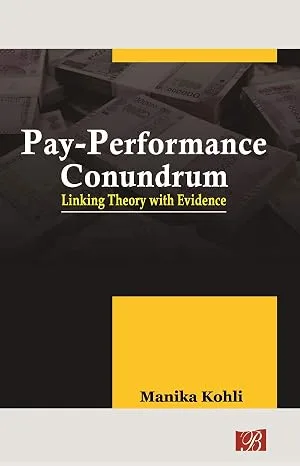
Download Cover Image
Do you want to download the full cover image for PAY-PERFORMANCE CONUNDRUM: Linking Theory with Evidence?