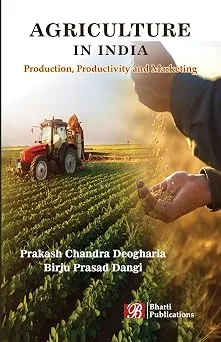
Agriculture in India: Production, Productivity and Marketing
Prakash Chandra Deogharia, Birju Prasad Dangi
Hardcover
• 256 Pages
• inr 860.00
• English
• 9788119757268
No ratings yet
| Publisher | Bharti Publications |
|---|---|
| Brand/Group | Bharti Publications |
| ISBN13 | 9788119757268 |
| ASIN/SKU | 8119757262 |
| Book Format | Hardcover |
| Language | English |
| Pages | 256 |
| List Price | inr 860.00 |
| Publishing Date | 02/01/2024 |
| Dimensions | 21.59 x 13.97 x 0.23 |
| Weight | 380 |
| Book Code | BD00070078 |
Buy this Book
Amazon Stores
Ebook Stores
Other Stores
Discover Agriculture in India: Production, Productivity and Marketing by Prakash Chandra Deogharia. This book is published by Bharti Publications in Hardcover format, ISBN 9788119757268, ASIN 8119757262.
Book Description
India is one of the fastest growing economies of the world. Agriculture plays an important though declining role in the Indian Economy. India has a large and diverse agriculture and is one of the world’s leading producers of agriculture produce. It is also a major consumer, with an expanding population to feed. For the above reason and because of its agriculture and trade policy, its presence in the world market has been modest in relation to the size of its agriculture. Agriculture occupies a prominent position in Indian policy making not only because of its contribution to GDP but also because of large proportion of the population that is dependent on the sector for its livelihood. Indian agriculture sector has made huge stride in developing its potential.
Author Biography
PRAKASH CHANDRA DEOGHARIA is presently University Head,
Department of Economics, Vinoba Bhave University, Hazaribagh (Jharkhand) and Dean Faculty of Social Sciences, of the Vinoba Bhave University. He started his career as a lecturer at Kartik Oraon College, Ratu, Ranchi in 1984. He obtained his master's degree from Ranchi University, Ranchi. He has made significant contribution in the area of regional development. He has been working on the issues related to Migration, Land Alienation, Displacement and Rehabilitation and Tribal Issues.
Dr. Deogharia has authored several books and published more than 50 research articles in refereed journal. He has been editing three research joumals since 2005. He has successfully supervised twenty PhD research scholars and currently ten PhD research scholars are working under him. His core theme of work relates to agriculture and rural development. He is leading research projects sponsored by Government of India and various organisation.
BIRJU PRASAD DANGI, MA, PhD in Economics, is a PGT teacher at K.B.+2
High School, Itkhori, Chatra (Jharkhand). His research interest covers regional development specially agriculture economics. Dr. Dangi has published many research papers and has carried out extensive and intensive field work in agriculture in the state of Jharkhand. Dr. Dangi has been working in the field of Agriculture Economics.
Department of Economics, Vinoba Bhave University, Hazaribagh (Jharkhand) and Dean Faculty of Social Sciences, of the Vinoba Bhave University. He started his career as a lecturer at Kartik Oraon College, Ratu, Ranchi in 1984. He obtained his master's degree from Ranchi University, Ranchi. He has made significant contribution in the area of regional development. He has been working on the issues related to Migration, Land Alienation, Displacement and Rehabilitation and Tribal Issues.
Dr. Deogharia has authored several books and published more than 50 research articles in refereed journal. He has been editing three research joumals since 2005. He has successfully supervised twenty PhD research scholars and currently ten PhD research scholars are working under him. His core theme of work relates to agriculture and rural development. He is leading research projects sponsored by Government of India and various organisation.
BIRJU PRASAD DANGI, MA, PhD in Economics, is a PGT teacher at K.B.+2
High School, Itkhori, Chatra (Jharkhand). His research interest covers regional development specially agriculture economics. Dr. Dangi has published many research papers and has carried out extensive and intensive field work in agriculture in the state of Jharkhand. Dr. Dangi has been working in the field of Agriculture Economics.
Editorial Reviews
Editorial Reviews will be added soon…
Book Summary
Agriculture has always occupied a central place in India's economic and social development. Despite the country's rapid transformation into one of the world's fastest-growing economies, agriculture continues to play a vital role in supporting livelihoods, ensuring food security, generating employment, and contributing to rural development. This book examines the changing landscape of Indian agriculture and explores its significance within the country's broader economic and developmental framework.
India possesses a vast and diverse agricultural sector, supported by varied climatic conditions, soil types, cropping patterns, and farming systems. The country is among the world's leading producers of several agricultural commodities and is also one of the largest consumers due to its growing population. This unique combination of production capacity and domestic demand makes Indian agriculture an important component of both the national economy and the global agricultural system.
The book provides an insightful examination of the role and evolution of agriculture in India, with particular attention to the changing contribution of the sector to the economy. While agriculture's share in national GDP has gradually declined as other sectors have expanded, its importance has not diminished. A substantial proportion of India's population continues to depend directly or indirectly on agriculture and allied activities for their livelihoods. Consequently, agricultural development remains closely connected with issues of rural prosperity, employment, poverty reduction, food security, and inclusive growth.
Another important dimension explored in the book is India's position in international agricultural markets. Although India has enormous agricultural production capabilities, its presence in global agricultural trade has historically remained modest in relation to the overall size of its agricultural sector. The book considers the influence of agricultural and trade policies, domestic consumption, production patterns, infrastructure, market access, and other factors that shape India's participation in the global market.
The book also highlights the remarkable progress made by Indian agriculture over the decades. Advances in agricultural technology, irrigation, improved seeds, mechanisation, research, institutional support, and changing farming practices have helped enhance the productive potential of the sector. At the same time, the changing agricultural environment presents new challenges, including resource constraints, climate variability, market uncertainties, fragmented landholdings, technological gaps, and the need to improve farmers' incomes and overall rural well-being.
By bringing together economic, developmental, policy, and agricultural perspectives, this book seeks to provide a comprehensive understanding of the opportunities and challenges confronting Indian agriculture. It emphasises the need for policies that balance productivity with sustainability, domestic food requirements with export opportunities, and economic growth with the welfare of farming communities.
The book will be useful for students, researchers, academicians, policymakers, agricultural professionals, economists, and readers interested in India's economy and rural development. It offers a valuable perspective on how the agricultural sector has evolved, the role it continues to play in India's development, and the opportunities that can shape its future.
Ultimately, the book underlines that the transformation of Indian agriculture is essential not only for strengthening the rural economy but also for achieving food security, inclusive growth, sustainable development, and a more resilient Indian economy.
India possesses a vast and diverse agricultural sector, supported by varied climatic conditions, soil types, cropping patterns, and farming systems. The country is among the world's leading producers of several agricultural commodities and is also one of the largest consumers due to its growing population. This unique combination of production capacity and domestic demand makes Indian agriculture an important component of both the national economy and the global agricultural system.
The book provides an insightful examination of the role and evolution of agriculture in India, with particular attention to the changing contribution of the sector to the economy. While agriculture's share in national GDP has gradually declined as other sectors have expanded, its importance has not diminished. A substantial proportion of India's population continues to depend directly or indirectly on agriculture and allied activities for their livelihoods. Consequently, agricultural development remains closely connected with issues of rural prosperity, employment, poverty reduction, food security, and inclusive growth.
Another important dimension explored in the book is India's position in international agricultural markets. Although India has enormous agricultural production capabilities, its presence in global agricultural trade has historically remained modest in relation to the overall size of its agricultural sector. The book considers the influence of agricultural and trade policies, domestic consumption, production patterns, infrastructure, market access, and other factors that shape India's participation in the global market.
The book also highlights the remarkable progress made by Indian agriculture over the decades. Advances in agricultural technology, irrigation, improved seeds, mechanisation, research, institutional support, and changing farming practices have helped enhance the productive potential of the sector. At the same time, the changing agricultural environment presents new challenges, including resource constraints, climate variability, market uncertainties, fragmented landholdings, technological gaps, and the need to improve farmers' incomes and overall rural well-being.
By bringing together economic, developmental, policy, and agricultural perspectives, this book seeks to provide a comprehensive understanding of the opportunities and challenges confronting Indian agriculture. It emphasises the need for policies that balance productivity with sustainability, domestic food requirements with export opportunities, and economic growth with the welfare of farming communities.
The book will be useful for students, researchers, academicians, policymakers, agricultural professionals, economists, and readers interested in India's economy and rural development. It offers a valuable perspective on how the agricultural sector has evolved, the role it continues to play in India's development, and the opportunities that can shape its future.
Ultimately, the book underlines that the transformation of Indian agriculture is essential not only for strengthening the rural economy but also for achieving food security, inclusive growth, sustainable development, and a more resilient Indian economy.
Sample Chapters
Sample Chapters will be added soon…
Reader Reviews
No reviews yet.
Agriculture in India: Production, Productivity and Marketing
Download Cover Image
Do you want to download the full cover image for Agriculture in India: Production, Productivity and Marketing?