
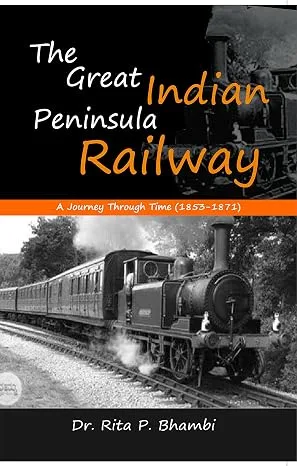
The Great Indian Peninsula Railway A Journey Through Time (1853-1871)
Hardcover
• 880 Pages
• inr 750.00
• English
• 9789385000768
No ratings yet
| Publisher | Bharti Publications |
|---|---|
| Brand/Group | Bharti Publications |
| ISBN13 | 9789385000768 |
| ASIN/SKU | 9789385000768 |
| Book Format | Hardcover |
| Language | English |
| Pages | 880 |
| List Price | inr 750.00 |
| Publishing Date | 01/01/2016 |
| Dimensions | 20 x 14 x 4 |
| Weight | 880 |
| Book Code | BD00070082 |
Buy this Book
Amazon Stores
Ebook Stores
Other Stores
Discover The Great Indian Peninsula Railway A Journey Through Time (1853-1871) by Dr. Rita P. Bhambi. This book is published by Bharti Publications in Hardcover format, ISBN 9789385000768, ASIN 9789385000768.
Book Description
Birth of railways constituted an important landmark in the history of India. They were launched and promoted by the British. It was undertaken by an associated enterprise with the capital coming from the share holders of a private com-pany and the Government acting as a supervisor and guarantor against the financial loss of the former. One such private company the Great Indian Peninsula Railway Company (henceforth referred as GIPR) was first to run a train for public on the Indian sub continent on 16th April 1853 and later became the nucleus of the current Central Railway. The aim of the book is to give a detailed and historical narrative regarding the construction and growth of the railways by the GIPR in India, an appreciation of the background against which the first tracks were laid and the expansion of the system since then. The large number of histories of the Railways and few on the GIPR have been published in times past is an indicator of its importance. However, there is one aspect of the GIPR which has not yet explored in detail that is the Contract System adopted by the Company for the construction of the railways. For the construction of the railway lines, Great Indian Peninsula Railway Company had followed the system of contracts and the lines were divided into different sections which were let to different contractors and each contract was given numbers. Total 19 Contracts were signed with contractors which are discussed in detailed in the book.
Author Biography
Author Biography will be added soon…
Editorial Reviews
Editorial Reviews will be added soon…
Book Summary
The birth of the railways marked a transformative milestone in the history of modern India. Introduced and promoted during British rule, the railway system fundamentally changed patterns of transportation, trade, communication, mobility, and economic activity across the subcontinent. Among the pioneering enterprises responsible for this remarkable development was the Great Indian Peninsula Railway Company (GIPR), whose history forms the central focus of this book.
On 16 April 1853, the GIPR operated the first passenger train on the Indian subcontinent, travelling from Bombay to Thane. This historic event marked the beginning of a railway network that would gradually expand across large parts of India and eventually form the foundation of what is now known as the Central Railway. The development of the GIPR was therefore not merely an engineering achievement but an important chapter in India's economic, administrative, and technological history.
This book presents a detailed historical narrative of the construction, development, and expansion of the railway system undertaken by the Great Indian Peninsula Railway Company. It examines the circumstances and historical background in which the first railway tracks were planned and constructed, providing readers with an understanding of the political, financial, administrative, and economic environment surrounding the emergence of railways in nineteenth-century India.
A distinctive feature of the book is its detailed examination of the contract system adopted by the GIPR for railway construction. While numerous works have documented the broader history of Indian railways and several studies have focused on the GIPR, the contractual arrangements through which railway lines were actually constructed have received comparatively limited attention. This book seeks to address that important gap.
For the construction of its railway lines, the GIPR divided the proposed routes into different sections and awarded individual sections to separate contractors. Each agreement was assigned a specific contract number and established the framework within which the construction work was undertaken. The book provides a detailed discussion of the nineteen contracts entered into by the GIPR with various contractors, examining their role in the construction and expansion of the railway network.
Through these contracts, the book sheds light on the practical realities behind the creation of India's early railway infrastructure. The contractual system provides an important lens through which to understand how large-scale railway projects were organised, financed, managed, and executed during the formative years of railway development. It also helps reveal the complexities involved in translating ambitious railway plans into physical infrastructure.
Beyond documenting the construction process, the book places the development of the GIPR within the broader history of colonial India. It highlights the significance of railway expansion in shaping economic activity and connecting different regions while also providing insight into the institutional and commercial structures through which railway development was pursued.
The Great Indian Peninsula Railway: Construction, Contracts and Growth in India will be valuable for historians, researchers, railway enthusiasts, students, academicians, and readers interested in India's colonial history, economic history, infrastructure development, and the evolution of Indian Railways. By focusing on an important but relatively underexplored aspect of railway history, the book contributes to a deeper understanding of the processes behind one of the most consequential infrastructural developments in nineteenth-century India.
Ultimately, this work goes beyond the familiar story of India's first train. It seeks to uncover the people, contracts, organisation, and historical circumstances behind the tracks, offering readers a closer look at how the Great Indian Peninsula Railway helped lay the foundations of India's modern railway system.
On 16 April 1853, the GIPR operated the first passenger train on the Indian subcontinent, travelling from Bombay to Thane. This historic event marked the beginning of a railway network that would gradually expand across large parts of India and eventually form the foundation of what is now known as the Central Railway. The development of the GIPR was therefore not merely an engineering achievement but an important chapter in India's economic, administrative, and technological history.
This book presents a detailed historical narrative of the construction, development, and expansion of the railway system undertaken by the Great Indian Peninsula Railway Company. It examines the circumstances and historical background in which the first railway tracks were planned and constructed, providing readers with an understanding of the political, financial, administrative, and economic environment surrounding the emergence of railways in nineteenth-century India.
A distinctive feature of the book is its detailed examination of the contract system adopted by the GIPR for railway construction. While numerous works have documented the broader history of Indian railways and several studies have focused on the GIPR, the contractual arrangements through which railway lines were actually constructed have received comparatively limited attention. This book seeks to address that important gap.
For the construction of its railway lines, the GIPR divided the proposed routes into different sections and awarded individual sections to separate contractors. Each agreement was assigned a specific contract number and established the framework within which the construction work was undertaken. The book provides a detailed discussion of the nineteen contracts entered into by the GIPR with various contractors, examining their role in the construction and expansion of the railway network.
Through these contracts, the book sheds light on the practical realities behind the creation of India's early railway infrastructure. The contractual system provides an important lens through which to understand how large-scale railway projects were organised, financed, managed, and executed during the formative years of railway development. It also helps reveal the complexities involved in translating ambitious railway plans into physical infrastructure.
Beyond documenting the construction process, the book places the development of the GIPR within the broader history of colonial India. It highlights the significance of railway expansion in shaping economic activity and connecting different regions while also providing insight into the institutional and commercial structures through which railway development was pursued.
The Great Indian Peninsula Railway: Construction, Contracts and Growth in India will be valuable for historians, researchers, railway enthusiasts, students, academicians, and readers interested in India's colonial history, economic history, infrastructure development, and the evolution of Indian Railways. By focusing on an important but relatively underexplored aspect of railway history, the book contributes to a deeper understanding of the processes behind one of the most consequential infrastructural developments in nineteenth-century India.
Ultimately, this work goes beyond the familiar story of India's first train. It seeks to uncover the people, contracts, organisation, and historical circumstances behind the tracks, offering readers a closer look at how the Great Indian Peninsula Railway helped lay the foundations of India's modern railway system.
Sample Chapters
Sample Chapters will be added soon…
Reader Reviews
No reviews yet.
The Great Indian Peninsula Railway A Journey Through Time (1853-1871)
Download Cover Image
Do you want to download the full cover image for The Great Indian Peninsula Railway A Journey Through Time (1853-1871)?