
Criminal Law, Evidence, and Forensics: A Comprehensive Legal Study
Yogesh Chandra Gupta, Dr. Namah Dutta
Hardcover
• 410 Pages
• inr 1580.00
• English
• 9789349566552
No ratings yet
| Publisher | Bharti Publications |
|---|---|
| Brand/Group | Bharti Publications |
| ISBN13 | 9789349566552 |
| ASIN/SKU | 9349566559 |
| Book Format | Hardcover |
| Language | English |
| Pages | 410 |
| List Price | inr 1580.00 |
| Publishing Date | 30/09/2025 |
| Dimensions | 15 x 3.5 x 21.5 |
| Weight | 495 |
| Book Code | BD00070128 |
Buy this Book
Amazon Stores
Ebook Stores
Other Stores
Discover Criminal Law, Evidence, and Forensics: A Comprehensive Legal Study by Yogesh Chandra Gupta. This book is published by Bharti Publications in Hardcover format, ISBN 9789349566552, ASIN 9349566559, under Law, Criminal Law.
Book Description
Criminal Law, Evidence, and Forensics: A Comprehensive Legal Study provides a comprehensive exploration of the interconnected fields of criminal law, law of evidence, and forensic science. Designed to bridge theoretical legal principles with practical approaches to criminal investigation and adjudication, the book offers readers a structured understanding of how criminal justice operates from investigation through trial.
Author Biography
Author Biography will be added soon…
Editorial Reviews
Editorial Reviews will be added soon…
Book Summary
Criminal Law, Evidence, and Forensics: A Comprehensive Legal Study provides a comprehensive exploration of the interconnected fields of criminal law, law of evidence, and forensic science. Designed to bridge theoretical legal principles with practical approaches to criminal investigation and adjudication, the book offers readers a structured understanding of how criminal justice operates from investigation through trial.
Criminal law establishes the framework for identifying offences, determining criminal responsibility, and imposing appropriate legal consequences. Evidence law, in turn, governs the manner in which facts are established before courts, including the relevance, admissibility, reliability, and evaluation of evidence. Forensic science complements both by providing scientific techniques and methodologies that assist investigators and courts in examining physical and digital traces associated with criminal activity.
The book examines the fundamental concepts and principles of criminal law while providing insight into contemporary developments in evidence and forensic investigation. It highlights the importance of proper collection, preservation, documentation, examination, and presentation of evidence, emphasizing how procedural accuracy and scientific reliability can significantly influence the outcome of criminal proceedings.
Particular attention is given to the growing role of forensic techniques in modern criminal justice. Scientific approaches such as forensic identification, biological and DNA evidence, toxicology, fingerprints, questioned documents, digital evidence, and other investigative methodologies have transformed the manner in which crimes are investigated and proved. The book considers both the opportunities and challenges associated with the increasing dependence on scientific and technological evidence.
The work also addresses the relationship between legal standards and scientific findings. It encourages readers to critically examine issues such as reliability, authenticity, evidentiary value, expert testimony, chain of custody, procedural safeguards, and the possibility of errors or misuse of forensic evidence. By bringing these perspectives together, the book demonstrates why effective criminal justice requires cooperation among legal practitioners, investigators, forensic experts, and the judiciary.
With its integrated approach, Criminal Law, Evidence, and Forensics: A Comprehensive Legal Study is a valuable academic and professional resource for law students, researchers, academicians, legal practitioners, judicial aspirants, investigators, forensic professionals, and anyone interested in criminal justice and contemporary legal processes.
Ultimately, the book seeks to develop a deeper understanding of how law, evidence, and science work together in the pursuit of justice, while emphasizing fairness, accuracy, due process, and the protection of individual rights within the criminal justice system.
Criminal law establishes the framework for identifying offences, determining criminal responsibility, and imposing appropriate legal consequences. Evidence law, in turn, governs the manner in which facts are established before courts, including the relevance, admissibility, reliability, and evaluation of evidence. Forensic science complements both by providing scientific techniques and methodologies that assist investigators and courts in examining physical and digital traces associated with criminal activity.
The book examines the fundamental concepts and principles of criminal law while providing insight into contemporary developments in evidence and forensic investigation. It highlights the importance of proper collection, preservation, documentation, examination, and presentation of evidence, emphasizing how procedural accuracy and scientific reliability can significantly influence the outcome of criminal proceedings.
Particular attention is given to the growing role of forensic techniques in modern criminal justice. Scientific approaches such as forensic identification, biological and DNA evidence, toxicology, fingerprints, questioned documents, digital evidence, and other investigative methodologies have transformed the manner in which crimes are investigated and proved. The book considers both the opportunities and challenges associated with the increasing dependence on scientific and technological evidence.
The work also addresses the relationship between legal standards and scientific findings. It encourages readers to critically examine issues such as reliability, authenticity, evidentiary value, expert testimony, chain of custody, procedural safeguards, and the possibility of errors or misuse of forensic evidence. By bringing these perspectives together, the book demonstrates why effective criminal justice requires cooperation among legal practitioners, investigators, forensic experts, and the judiciary.
With its integrated approach, Criminal Law, Evidence, and Forensics: A Comprehensive Legal Study is a valuable academic and professional resource for law students, researchers, academicians, legal practitioners, judicial aspirants, investigators, forensic professionals, and anyone interested in criminal justice and contemporary legal processes.
Ultimately, the book seeks to develop a deeper understanding of how law, evidence, and science work together in the pursuit of justice, while emphasizing fairness, accuracy, due process, and the protection of individual rights within the criminal justice system.
Sample Chapters
Sample Chapters will be added soon…
Reader Reviews
No reviews yet.
Criminal Law, Evidence, and Forensics: A Comprehensive Legal Study
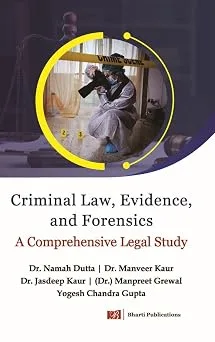
Download Cover Image
Do you want to download the full cover image for Criminal Law, Evidence, and Forensics: A Comprehensive Legal Study?