
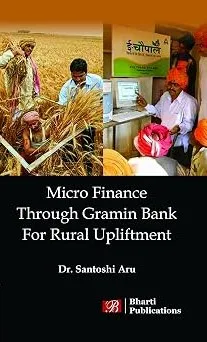
Microfinance Through Gramin Bank for Rural Upliftment
Hardcover
• 220 Pages
• inr 785.00
• English
• 9789394779389
No ratings yet
| Publisher | Bharti Publications |
|---|---|
| Brand/Group | Bharti Publications |
| ISBN13 | 9789394779389 |
| ASIN/SKU | 9394779388 |
| Book Format | Hardcover |
| Language | English |
| Pages | 220 |
| List Price | inr 785.00 |
| Publishing Date | 25/08/2022 |
| Dimensions | 14 x 2 x 21.25 |
| Weight | 425 |
| Book Code | BD00070139 |
Buy this Book
Amazon Stores
Ebook Stores
Other Stores
Discover Microfinance Through Gramin Bank for Rural Upliftment by Dr. Santoshi Aru. This book is published by Bharti Publications in Hardcover format, ISBN 9789394779389, ASIN 9394779388.
Book Description
Microfinance has played a key role in financial Inclusion in India, because it came into existence mainly to serve the smaller and overlooked sections of society. Microfinance may be a quite financial services that targets individuals and little businesses that lack access to market conventional banking and other related services. Micro finance is the provision of a broad range of financial services such as deposits, loans, payments services, money transfers and insurances to poor low income households and their micro enterprises. The poor need a diverse range of financial instruments to be able to build assets, stabilize consumption and protect themselves again risks. The typical micro finance clients are low-income persons who do not have access to formal financial institutions. Micro Finance clients are self-employed and household based entrepreneurs. Experience shows that micro finance can help the poor to increase income, build viable business and reduce their vulnerability to external shocks.
Author Biography
Dr. Santoshi Aru has obtained her master degree in Commerce from Ranchi University, Ranchi and completed her PhD in commerce from Ranchi University Ranchi, Jharkahnd. She has good teaching experience to graduate and post graduate students. Presently, she is working as an Assistant Professor in BBA department, Ranchi Women’s College, Racnhi, Jharkhand. She has published various research papers in National and International Journals of repute. Dr Aru has been regularly publishing chapter in edited book. She has also participated and presented his research in various National and International Conferences, Seminars and Webinars.
Editorial Reviews
Editorial Reviews will be added soon…
Book Summary
Microfinance and Financial Inclusion in India explores the important role of microfinance in expanding access to financial services among underserved and economically vulnerable sections of society. Microfinance emerged primarily to address the needs of individuals and small enterprises that have traditionally faced difficulties in accessing conventional banking and formal financial institutions. In the Indian context, it has become an important instrument for promoting financial inclusion, supporting livelihoods, encouraging entrepreneurship, and strengthening the economic participation of low-income households.
The book examines microfinance as more than simply the provision of small loans. It presents microfinance as a broad range of financial services that may include deposits, credit, payment services, money transfers, and insurance, designed to meet the diverse financial needs of low-income households and micro-enterprises. Access to such services can enable individuals and families to manage their financial resources more effectively, build assets, stabilize consumption, and protect themselves against unexpected economic risks.
A major focus of the book is the relationship between microfinance and financial inclusion. A significant section of the population, particularly in economically disadvantaged communities, may remain outside the formal financial system because of limited income, lack of collateral, geographical barriers, or inadequate access to conventional banking facilities. Microfinance seeks to bridge this gap by providing financial products and services that are more accessible to people who are traditionally excluded from formal financial institutions.
The book also highlights the characteristics and needs of typical microfinance clients. These often include low-income individuals, self-employed persons, and household-based entrepreneurs who rely on small-scale economic activities for their livelihoods. For such individuals, access to appropriate financial services can provide opportunities to invest in productive activities, expand small businesses, generate income, and improve household economic stability.
Another important theme is the potential of microfinance to contribute to poverty reduction and economic empowerment. By facilitating access to capital and other financial services, microfinance can help individuals develop viable businesses and strengthen their earning capacity. It can also enhance the ability of households to cope with external shocks and financial uncertainties, thereby reducing their economic vulnerability.
The book presents microfinance within the broader framework of inclusive development, emphasizing the need for financial systems that respond to the realities of underserved communities. It demonstrates how access to appropriate financial services can contribute not only to individual economic improvement but also to wider social and economic development.
Overall, Microfinance and Financial Inclusion in India provides a useful foundation for understanding the significance, scope, and potential of microfinance in promoting inclusive financial development. It will be valuable for students, researchers, academicians, policymakers, banking and financial professionals, development practitioners, and readers interested in poverty alleviation, entrepreneurship, rural development, and financial inclusion. By highlighting the financial needs of underserved communities and the role of microfinance in addressing them, the book contributes to a broader understanding of how inclusive financial services can support sustainable economic opportunities and improved livelihoods.
The book examines microfinance as more than simply the provision of small loans. It presents microfinance as a broad range of financial services that may include deposits, credit, payment services, money transfers, and insurance, designed to meet the diverse financial needs of low-income households and micro-enterprises. Access to such services can enable individuals and families to manage their financial resources more effectively, build assets, stabilize consumption, and protect themselves against unexpected economic risks.
A major focus of the book is the relationship between microfinance and financial inclusion. A significant section of the population, particularly in economically disadvantaged communities, may remain outside the formal financial system because of limited income, lack of collateral, geographical barriers, or inadequate access to conventional banking facilities. Microfinance seeks to bridge this gap by providing financial products and services that are more accessible to people who are traditionally excluded from formal financial institutions.
The book also highlights the characteristics and needs of typical microfinance clients. These often include low-income individuals, self-employed persons, and household-based entrepreneurs who rely on small-scale economic activities for their livelihoods. For such individuals, access to appropriate financial services can provide opportunities to invest in productive activities, expand small businesses, generate income, and improve household economic stability.
Another important theme is the potential of microfinance to contribute to poverty reduction and economic empowerment. By facilitating access to capital and other financial services, microfinance can help individuals develop viable businesses and strengthen their earning capacity. It can also enhance the ability of households to cope with external shocks and financial uncertainties, thereby reducing their economic vulnerability.
The book presents microfinance within the broader framework of inclusive development, emphasizing the need for financial systems that respond to the realities of underserved communities. It demonstrates how access to appropriate financial services can contribute not only to individual economic improvement but also to wider social and economic development.
Overall, Microfinance and Financial Inclusion in India provides a useful foundation for understanding the significance, scope, and potential of microfinance in promoting inclusive financial development. It will be valuable for students, researchers, academicians, policymakers, banking and financial professionals, development practitioners, and readers interested in poverty alleviation, entrepreneurship, rural development, and financial inclusion. By highlighting the financial needs of underserved communities and the role of microfinance in addressing them, the book contributes to a broader understanding of how inclusive financial services can support sustainable economic opportunities and improved livelihoods.
Sample Chapters
Sample Chapters will be added soon…
Reader Reviews
No reviews yet.
Microfinance Through Gramin Bank for Rural Upliftment
Download Cover Image
Do you want to download the full cover image for Microfinance Through Gramin Bank for Rural Upliftment?