Shaping the Global Order: Geopolitical Logics and Institutional Shifts
Prof. (Dr.) M. L. Meena, Ravi Dass
Hardcover
• 224 Pages
• inr 1280.00
• English
• 978-81-69155-25-0
No ratings yet
| Publisher | Bharti Publications |
|---|---|
| Brand/Group | Bharti Publications |
| ISBN13 | 978-81-69155-25-0 |
| ASIN/SKU | 8169155258 |
| Book Format | Hardcover |
| Language | English |
| Pages | 224 |
| List Price | inr 1280.00 |
| Publishing Date | 19/06/2026 |
| Dimensions | 14 x 1.7 x 21.5 |
| Weight | 350 |
| Book Code | BD00070507 |
Buy this Book
Amazon Stores
Ebook Stores
Other Stores
Discover Shaping the Global Order: Geopolitical Logics and Institutional Shifts by Prof. (Dr.) M. L. Meena. This book is published by Bharti Publications in Hardcover format, ISBN 978-81-69155-25-0, ASIN 8169155258.
Book Description
The global order has never been a finished structure. It has always been a work in motion, assembled through wars and treaties, sustained by institutions, challenged by crises and periodically rewritten by shifts in power and ideas. that once stabilized world politics no longer hold. We are living through one such moment. This book emerges from the recognition that the contemporary global order is not merely changing; it is being recomposed. The familiar grammar of international relations, built around post-Second World War liberal institutionalism, U.S.-centric leadership, Bretton Woods financial arrangements and UN-centered multilateralism, is increasingly strained. In its place, we observe a fragmented yet dynamic landscape marked by competing power centers, fluid alliances, resurgent territorial logics, technological disruptions or contested institutional legitimacy.
Author Biography
Prof. (Dr.) M. L. Meena is a Professor and Head of the Department of Geography, School of Basic Sciences, Central University of Haryana, Mahendergarh. A distinguished academician, researcher, and strategic thinker, he has made significant contributions to the fields of Political Geography, Geopolitics of Resources and the Indo-Pacific Region. With more than 18 years of teaching, research, and academic leadership experience, he has successfully led and participated in several research projects supported by government and academic institutions.
Ravi Dass is an Assistant Professor (HES-II) in the Department of Higher Education, Government College, Goriwala, Govt of Haryana. Belonging to a new generation of Indian geographers, his work bridges Human Geography, Public Policy, Political Geography, International Relations, and Indo-Pacific Studies, with a particular focus on the relationship between geography, power, development, and strategic affairs.
Dr. Monika Jagdish Dara is an Assistant Professor in Public Administration at Post Graduate Government College, Sector-11, Chandigarh (affiliated to Panjab University, Chandigarh). She holds a Ph.D. from Kurukshetra University on State Supervision and Control over Panchayati Raj Institutions in Haryana. Her academic interests include international governance studies, geopolitics of organizations, organizational behaviour, decentralization of power, public policy and the administrative dimensions of state functioning.
Ravi Dass is an Assistant Professor (HES-II) in the Department of Higher Education, Government College, Goriwala, Govt of Haryana. Belonging to a new generation of Indian geographers, his work bridges Human Geography, Public Policy, Political Geography, International Relations, and Indo-Pacific Studies, with a particular focus on the relationship between geography, power, development, and strategic affairs.
Dr. Monika Jagdish Dara is an Assistant Professor in Public Administration at Post Graduate Government College, Sector-11, Chandigarh (affiliated to Panjab University, Chandigarh). She holds a Ph.D. from Kurukshetra University on State Supervision and Control over Panchayati Raj Institutions in Haryana. Her academic interests include international governance studies, geopolitics of organizations, organizational behaviour, decentralization of power, public policy and the administrative dimensions of state functioning.
Editorial Reviews
Editorial Reviews will be added soon…
Book Summary
The global order has never been a finished or permanently settled structure. Throughout history, it has continuously evolved through wars and treaties, institutions and alliances, economic transformations, technological developments, crises, and shifts in political power and ideas. The international system that emerged after the Second World War provided a framework for global stability for decades, but many of its underlying assumptions and institutions are now facing unprecedented pressures.
This book explores the profound transformation currently taking place in the global political and economic order. It argues that the contemporary international system is not simply undergoing gradual change; rather, it is being fundamentally recomposed as established structures interact with emerging powers, competing interests, technological disruption, and new forms of geopolitical contestation.
The familiar architecture of international relations—shaped by post-Second World War liberal institutionalism, U.S.-centric leadership, Bretton Woods financial institutions, and UN-centered multilateralism—is increasingly being challenged. New centres of political and economic power are emerging, traditional alliances are becoming more fluid, and established institutions are facing questions about their effectiveness, legitimacy, and ability to respond to contemporary global challenges.
Against this background, the book examines the emergence of a more fragmented yet highly dynamic international landscape. The return of territorial and geopolitical competition, changing patterns of influence, strategic rivalries, economic interdependence, technological transformation, and shifting alliances are reshaping the ways in which states interact with one another. These developments raise important questions about the future direction of international cooperation and the principles that will govern global affairs.
The book also considers how established institutions and norms are adapting—or struggling to adapt—to a rapidly changing world. The growing importance of emerging and middle powers, the contestation of global governance mechanisms, and the increasing influence of technology and economic power suggest that the future international order may be considerably more pluralistic and complex than the one that dominated the previous decades.
Rather than presenting the transformation of the global order as a simple transition from one dominant system to another, this work emphasizes the uncertainty, competition, and complexity that characterize the current moment. Multiple power centres, overlapping partnerships, competing institutional frameworks, and divergent visions of global governance are developing simultaneously. The result is an international environment in which cooperation and competition increasingly coexist.
Ultimately, the book invites readers to reconsider conventional assumptions about international relations and to think critically about what a changing global order means for states, institutions, economies, and societies. It explores whether existing structures can adapt to new realities and whether emerging arrangements will produce greater cooperation, deeper fragmentation, or an entirely new form of global governance.
By examining the forces reshaping contemporary international politics, this volume offers a timely perspective on one of the defining questions of our era: What kind of global order is emerging, and who will shape it?
The book will be valuable for students, researchers, academics, policymakers, diplomats, and readers interested in international relations, geopolitics, global governance, political economy, strategic studies, and contemporary world affairs. It provides a framework for understanding a world in transition—one in which the rules, institutions, and distribution of power that once defined global politics are being questioned, renegotiated, and rewritten.
This book explores the profound transformation currently taking place in the global political and economic order. It argues that the contemporary international system is not simply undergoing gradual change; rather, it is being fundamentally recomposed as established structures interact with emerging powers, competing interests, technological disruption, and new forms of geopolitical contestation.
The familiar architecture of international relations—shaped by post-Second World War liberal institutionalism, U.S.-centric leadership, Bretton Woods financial institutions, and UN-centered multilateralism—is increasingly being challenged. New centres of political and economic power are emerging, traditional alliances are becoming more fluid, and established institutions are facing questions about their effectiveness, legitimacy, and ability to respond to contemporary global challenges.
Against this background, the book examines the emergence of a more fragmented yet highly dynamic international landscape. The return of territorial and geopolitical competition, changing patterns of influence, strategic rivalries, economic interdependence, technological transformation, and shifting alliances are reshaping the ways in which states interact with one another. These developments raise important questions about the future direction of international cooperation and the principles that will govern global affairs.
The book also considers how established institutions and norms are adapting—or struggling to adapt—to a rapidly changing world. The growing importance of emerging and middle powers, the contestation of global governance mechanisms, and the increasing influence of technology and economic power suggest that the future international order may be considerably more pluralistic and complex than the one that dominated the previous decades.
Rather than presenting the transformation of the global order as a simple transition from one dominant system to another, this work emphasizes the uncertainty, competition, and complexity that characterize the current moment. Multiple power centres, overlapping partnerships, competing institutional frameworks, and divergent visions of global governance are developing simultaneously. The result is an international environment in which cooperation and competition increasingly coexist.
Ultimately, the book invites readers to reconsider conventional assumptions about international relations and to think critically about what a changing global order means for states, institutions, economies, and societies. It explores whether existing structures can adapt to new realities and whether emerging arrangements will produce greater cooperation, deeper fragmentation, or an entirely new form of global governance.
By examining the forces reshaping contemporary international politics, this volume offers a timely perspective on one of the defining questions of our era: What kind of global order is emerging, and who will shape it?
The book will be valuable for students, researchers, academics, policymakers, diplomats, and readers interested in international relations, geopolitics, global governance, political economy, strategic studies, and contemporary world affairs. It provides a framework for understanding a world in transition—one in which the rules, institutions, and distribution of power that once defined global politics are being questioned, renegotiated, and rewritten.
Sample Chapters
Sample Chapters will be added soon…
Reader Reviews
No reviews yet.
Shaping the Global Order: Geopolitical Logics and Institutional Shifts
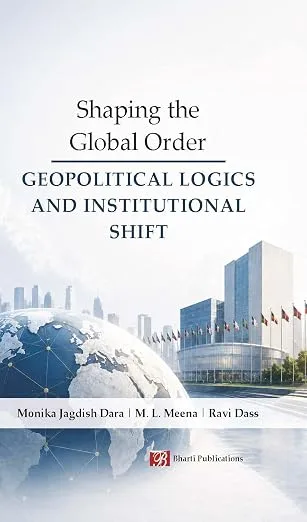
Download Cover Image
Do you want to download the full cover image for Shaping the Global Order: Geopolitical Logics and Institutional Shifts?