
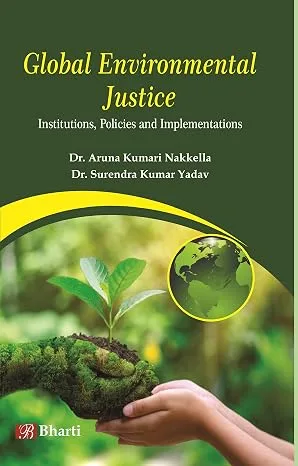
Global Environmental Justice: Institutions, Policies and Implementations
Dr. Aruna Kumari Nakkella, Dr. Surendra Kumar Yadav
Hardcover
• 375 Pages
• inr 1280.00
• English
• 978-93-90818-44-0
No ratings yet
| Publisher | Bharti Publications |
|---|---|
| Brand/Group | Bharti Publications |
| ISBN13 | 978-93-90818-44-0 |
| ASIN/SKU | 9390818443 |
| Book Format | Hardcover |
| Language | English |
| Pages | 375 |
| List Price | inr 1280.00 |
| Publishing Date | 27/07/2021 |
| Dimensions | 14 x 2.5 x 21.5 |
| Book Code | BD00070594 |
Buy this Book
Amazon Stores
Ebook Stores
Other Stores
Discover Global Environmental Justice: Institutions, Policies and Implementations by Dr. Aruna Kumari Nakkella. This book is published by Bharti Publications in Hardcover format, ISBN 978-93-90818-44-0, ASIN 9390818443.
Book Description
Earth’s resources, while vast, are finite. Increasingly, humans have come to realize that we must be better stewards of those resources and that economic activity must be carried out in ways that do not compromise the ability of future generations to prosper. The sustainability challenge is to develop innovations and policies that allow humanity to meet current and future environmental, human health, economic, and societal needs.As governments strive to tackle inter-related challenges such as energy and materials security, climate change and pollution. Based on abundant scientific evidence or our own current experiences, we recognize that the global climate is rapidly warming and becoming increasingly unstable due to human-caused atmospheric carbon pollution primarily from the burning of fossil fuels.Author also recognize that in spite of 35 years of credible scientific warnings, global warming is still rising and has now reached dangerous levels! This book is the result of facilitating, researching of teaching fraternity from all over India. This book places a clear emphasis on research skills of teachers and also ensures that those skills are based on rigorous and current research. This book uses realistic examples to help the society get inside what group work is really like. In addition to this, it will help to distinguish between effective and best practices as well as to help them to identify these best practices they wish to adopt to improve their research interaction. This framework allows the authors and readers to place new information and skills development into a larger context of innovation. Approach the title of this book, it allows in communicating in Groups Building Relationships for Effectiveness of both researchers and teachers. In this, the authors and readers will discover the unique dynamics of communication of their own research work and the essential skills that lead to success, and the roles, tasks, and processes that pave the way for ef
Author Biography
Author Biography will be added soon…
Editorial Reviews
Editorial Reviews will be added soon…
Book Summary
Earth’s natural resources are vast but finite, making sustainability one of the most important challenges facing humanity today. As economic and technological activities continue to expand, there is an urgent need to ensure that present development does not compromise the ability of future generations to meet their environmental, social, health, and economic needs. This book explores the growing sustainability challenges facing society and highlights the importance of innovative thinking, responsible policies, and collaborative research in addressing them.
Among the major challenges discussed are climate change, pollution, energy security, materials security, and the responsible use of natural resources. Strong scientific evidence and contemporary experiences demonstrate that human activities, particularly the continued burning of fossil fuels, have contributed significantly to rising atmospheric carbon emissions and global warming. Despite decades of scientific warnings, climate change continues to intensify, creating serious consequences for ecosystems, human health, economies, and communities.
The book is the outcome of research, teaching, and academic engagement with members of the teaching fraternity from across India. It places particular emphasis on strengthening the research skills of teachers and researchers through rigorous, relevant, and contemporary approaches. It recognizes that effective research is not limited to individual knowledge and expertise but also depends on communication, collaboration, teamwork, and the ability to build productive professional relationships.
Through realistic examples and practical discussions, the book provides readers with an understanding of what effective group work and research interaction involve. It helps distinguish between ordinary practices and effective or best practices, enabling teachers and researchers to identify approaches that can improve their research activities, collaboration, and professional interactions.
An important theme of the book is communication within groups. Effective communication is essential for developing relationships, sharing knowledge, resolving challenges, coordinating research activities, and achieving common goals. By examining the dynamics of group communication, the book encourages readers to understand their own communication styles and recognize the roles, responsibilities, tasks, and processes that contribute to successful teamwork.
The framework presented in the book connects research skills, communication, collaboration, innovation, and sustainability within a broader context. It encourages readers to apply new knowledge and develop practical skills that can contribute to more effective research and teaching practices. In doing so, the book serves as a useful resource for teachers, researchers, academic professionals, and others interested in improving collaborative research and educational practices.
Overall, this book emphasizes that addressing complex global challenges requires more than scientific knowledge alone. It requires effective communication, meaningful collaboration, innovative thinking, and responsible action. By bringing these elements together, the book provides a practical and research-oriented perspective on building stronger relationships and more effective groups among teachers and researchers, ultimately contributing to a more sustainable and knowledge-driven society.
Among the major challenges discussed are climate change, pollution, energy security, materials security, and the responsible use of natural resources. Strong scientific evidence and contemporary experiences demonstrate that human activities, particularly the continued burning of fossil fuels, have contributed significantly to rising atmospheric carbon emissions and global warming. Despite decades of scientific warnings, climate change continues to intensify, creating serious consequences for ecosystems, human health, economies, and communities.
The book is the outcome of research, teaching, and academic engagement with members of the teaching fraternity from across India. It places particular emphasis on strengthening the research skills of teachers and researchers through rigorous, relevant, and contemporary approaches. It recognizes that effective research is not limited to individual knowledge and expertise but also depends on communication, collaboration, teamwork, and the ability to build productive professional relationships.
Through realistic examples and practical discussions, the book provides readers with an understanding of what effective group work and research interaction involve. It helps distinguish between ordinary practices and effective or best practices, enabling teachers and researchers to identify approaches that can improve their research activities, collaboration, and professional interactions.
An important theme of the book is communication within groups. Effective communication is essential for developing relationships, sharing knowledge, resolving challenges, coordinating research activities, and achieving common goals. By examining the dynamics of group communication, the book encourages readers to understand their own communication styles and recognize the roles, responsibilities, tasks, and processes that contribute to successful teamwork.
The framework presented in the book connects research skills, communication, collaboration, innovation, and sustainability within a broader context. It encourages readers to apply new knowledge and develop practical skills that can contribute to more effective research and teaching practices. In doing so, the book serves as a useful resource for teachers, researchers, academic professionals, and others interested in improving collaborative research and educational practices.
Overall, this book emphasizes that addressing complex global challenges requires more than scientific knowledge alone. It requires effective communication, meaningful collaboration, innovative thinking, and responsible action. By bringing these elements together, the book provides a practical and research-oriented perspective on building stronger relationships and more effective groups among teachers and researchers, ultimately contributing to a more sustainable and knowledge-driven society.
Sample Chapters
Sample Chapters will be added soon…
Reader Reviews
No reviews yet.
Global Environmental Justice: Institutions, Policies and Implementations
Download Cover Image
Do you want to download the full cover image for Global Environmental Justice: Institutions, Policies and Implementations?