
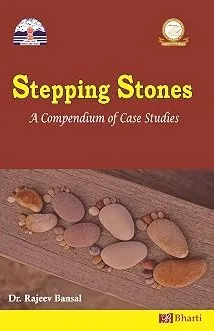
Stepping Stones: A Compendium of Case Studies
Dr. Rajeev Bansal, IAS C. P. Verma
Hardcover
• 92 Pages
• inr 350.00
• English
• 978-93-90818-31-0
No ratings yet
| Publisher | Bharti Publications |
|---|---|
| Brand/Group | Bharti Publications |
| ISBN13 | 978-93-90818-31-0 |
| ASIN/SKU | 9390818311 |
| Book Format | Hardcover |
| Language | English |
| Pages | 92 |
| List Price | inr 350.00 |
| Publishing Date | 01/02/2021 |
| Dimensions | 14.5 x 1.5 x 21.5 |
| Weight | 350 |
| Book Code | BD00070604 |
Buy this Book
Amazon Stores
Ebook Stores
Other Stores
Discover Stepping Stones: A Compendium of Case Studies by Dr. Rajeev Bansal. This book is published by Bharti Publications in Hardcover format, ISBN 978-93-90818-31-0, ASIN 9390818311.
Book Description
The book has been attempted on the basis of different situations faced by the officials in the sector of development administration. The inputs for developing the cases has been provided by the different officials in workshop and training programmes organised in the Institute. We are grateful for their valuable inputs without which it was not possible to attempt the present document. It is hoped that these cases will help the faculty in the training institutions to imbibe the appropriate knowledge and learning to the participants. I place on record the efforts put in by Dr. Rajeev Bansal, Joint Director (Training & Research) in writing the compendium containing valuable case studies and introductory chapters on use of case method in training. The comments, suggestions and observations from all the stakeholders are invited to enrich the document in future.
Author Biography
Author Biography will be added soon…
Editorial Reviews
Editorial Reviews will be added soon…
Book Summary
This book is a compilation of case studies developed from the diverse situations, challenges, and experiences encountered by officials working in the field of Development Administration. The cases are based on practical experiences and real-life situations shared by officials during various workshops and training programmes organized by the Institute. Their valuable contributions and insights have provided an important foundation for developing this collection.
The primary objective of the book is to provide a practical and effective learning resource for participants and faculty involved in training and capacity-building programmes. By presenting realistic administrative situations through case studies, the book encourages readers to examine problems from multiple perspectives, understand the complexities of decision-making, and develop appropriate approaches to addressing challenges in development administration.
Case-based learning provides an opportunity to connect theoretical knowledge with practical situations. The cases presented in this book are intended to help participants analyze administrative problems, identify possible solutions, evaluate alternative courses of action, and develop the knowledge and skills required for effective performance in their professional roles.
The book is particularly useful for faculty members of training institutions, as it provides practical material that can be incorporated into training programmes and classroom discussions. It can also help trainers encourage active participation, critical thinking, problem-solving, and experience-based learning among participants.
An important feature of the book is its introductory discussion on the use of the case method in training. This provides a framework for understanding how case studies can be effectively used as a teaching and learning tool. The combination of introductory chapters and practical case studies makes the book a useful reference for trainers, administrators, researchers, and professionals engaged in development administration and public-sector capacity building.
The preparation of this compendium represents a collaborative effort involving officials, trainers, faculty members, and other stakeholders. The valuable inputs received through workshops and training programmes have enriched the cases and helped ensure that they reflect practical realities encountered in the field.
Special recognition is given to Dr. Rajeev Bansal, Joint Director (Training & Research), for his efforts in preparing the compendium and contributing valuable case studies and introductory chapters on the application of the case method in training.
Overall, this book seeks to bridge the gap between theoretical understanding and practical administrative experience. It provides readers with opportunities to reflect on real-world situations, develop analytical abilities, strengthen decision-making skills, and enhance their understanding of development administration. The book also remains open to further improvement through comments, suggestions, observations, and experiences from stakeholders, thereby allowing it to evolve as a richer and more relevant resource for future training and learning.
The primary objective of the book is to provide a practical and effective learning resource for participants and faculty involved in training and capacity-building programmes. By presenting realistic administrative situations through case studies, the book encourages readers to examine problems from multiple perspectives, understand the complexities of decision-making, and develop appropriate approaches to addressing challenges in development administration.
Case-based learning provides an opportunity to connect theoretical knowledge with practical situations. The cases presented in this book are intended to help participants analyze administrative problems, identify possible solutions, evaluate alternative courses of action, and develop the knowledge and skills required for effective performance in their professional roles.
The book is particularly useful for faculty members of training institutions, as it provides practical material that can be incorporated into training programmes and classroom discussions. It can also help trainers encourage active participation, critical thinking, problem-solving, and experience-based learning among participants.
An important feature of the book is its introductory discussion on the use of the case method in training. This provides a framework for understanding how case studies can be effectively used as a teaching and learning tool. The combination of introductory chapters and practical case studies makes the book a useful reference for trainers, administrators, researchers, and professionals engaged in development administration and public-sector capacity building.
The preparation of this compendium represents a collaborative effort involving officials, trainers, faculty members, and other stakeholders. The valuable inputs received through workshops and training programmes have enriched the cases and helped ensure that they reflect practical realities encountered in the field.
Special recognition is given to Dr. Rajeev Bansal, Joint Director (Training & Research), for his efforts in preparing the compendium and contributing valuable case studies and introductory chapters on the application of the case method in training.
Overall, this book seeks to bridge the gap between theoretical understanding and practical administrative experience. It provides readers with opportunities to reflect on real-world situations, develop analytical abilities, strengthen decision-making skills, and enhance their understanding of development administration. The book also remains open to further improvement through comments, suggestions, observations, and experiences from stakeholders, thereby allowing it to evolve as a richer and more relevant resource for future training and learning.
Sample Chapters
Sample Chapters will be added soon…
Reader Reviews
No reviews yet.
Stepping Stones: A Compendium of Case Studies
Download Cover Image
Do you want to download the full cover image for Stepping Stones: A Compendium of Case Studies?