
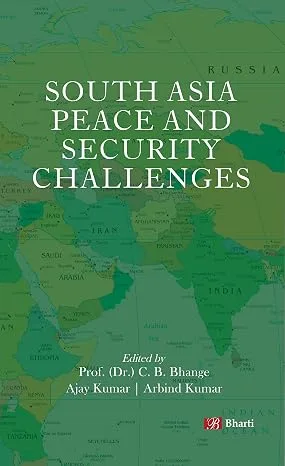
South Asia Peace and Security Challenges
Hardcover
• 296 Pages
• inr 980.00
• English
• 978-93-90818-03-7
No ratings yet
| Publisher | Bharti Publications |
|---|---|
| Brand/Group | Bharti Publications |
| ISBN13 | 978-93-90818-03-7 |
| ASIN/SKU | 9390818036 |
| Book Format | Hardcover |
| Language | English |
| Pages | 296 |
| List Price | inr 980.00 |
| Publishing Date | 21/01/2021 |
| Dimensions | 13.75 x 2 x 21.5 |
| Weight | 499 |
| Book Code | BD00070652 |
Buy this Book
Amazon Stores
Ebook Stores
Other Stores
Discover South Asia Peace and Security Challenges by Prof. (Dr.) C. B. Bhange. This book is published by Bharti Publications in Hardcover format, ISBN 978-93-90818-03-7, ASIN 9390818036.
Book Description
The book “South Asia Peace and Security Challenges” study the challenges and issues to South Asia Peace and Security. The goal of this book is to inform the people about various dimensions of South Asian Peace and Security. This book will be very useful for students and researchers studying challenges and issues of South Asian Peace and Security. A notable feature of this book is that researchers have set out in their research papers on current developments and historical views on challenges and issues to South Asia Peace and Security. South Asia is a geographical region of the Asian continent. This region includes the territory of the Indian subcontinent. Geographically, South Asia is located on the Indian plateau south of the Himalayas and the Hindu Kush Mountains, with the Indian Ocean to the south. India, Pakistan, Bangladesh, Sri Lanka, Nepal, Afghanistan, Bhutan and Maldives are the eight countries generally considered to be South Asian countries. South Asian countries established SAARC in 1985 to strengthen regional political and trade ties and ratified the South Asian Free Trade Agreement in 2004. In general, issues like poverty, health, technological backwardness, regional conflicts, population, pollution, illiteracy, and lack of infrastructure, lack of unity, corruption, terrorism, and conflict among nations are problems in South Asia. For the better understanding of the issues with South Asia Peace and Security Challenges, the compiled the book on “South Asia Peace and Security Challenges”
Author Biography
Author Biography will be added soon…
Editorial Reviews
Editorial Reviews will be added soon…
Book Summary
South Asia Peace and Security Challenges examines the complex and multidimensional challenges affecting peace, security, stability, and development in South Asia. The book seeks to provide a comprehensive understanding of the political, social, economic, historical, and contemporary factors that influence peace and security in the region.
South Asia is a strategically significant geographical region comprising the countries of the Indian subcontinent. India, Pakistan, Bangladesh, Sri Lanka, Nepal, Afghanistan, Bhutan, and Maldives are generally regarded as the eight South Asian countries. The region possesses considerable cultural, historical, demographic, and economic diversity, but it also faces a range of interconnected challenges that have significant implications for regional peace and stability.
The establishment of the South Asian Association for Regional Cooperation (SAARC) in 1985 represented an important effort toward strengthening regional cooperation, political understanding, economic relations, and collective development. Similarly, the adoption of the South Asian Free Trade Agreement (SAFTA) in 2004 reflected aspirations for greater economic integration and stronger regional trade relations. However, despite these initiatives, South Asia continues to experience considerable obstacles to effective regional cooperation.
The book brings together research contributions that examine both historical perspectives and current developments relating to peace and security in South Asia. The chapters address a broad range of issues, including regional conflicts, terrorism, political instability, poverty, illiteracy, corruption, population pressures, health challenges, technological backwardness, environmental pollution, inadequate infrastructure, and the lack of regional unity and cooperation. These challenges are often interconnected and require coordinated approaches at both national and regional levels.
Particular attention is given to the complex relationships among South Asian countries and the factors that contribute to regional tensions and insecurity. Historical experiences, territorial disputes, political differences, economic inequalities, security concerns, and competing national interests continue to influence inter-state relations. At the same time, emerging challenges such as technological change, environmental concerns, population growth, and socio-economic inequalities have added new dimensions to the region's security landscape.
By bringing together diverse scholarly perspectives, this volume attempts to provide a deeper understanding of the factors that hinder peace and cooperation in South Asia while also highlighting the possibilities for a more stable and prosperous region. The contributions encourage readers to consider the importance of dialogue, regional cooperation, economic integration, social development, and collaborative approaches to addressing common challenges.
South Asia Peace and Security Challenges will be a valuable resource for students, researchers, academicians, policymakers, and scholars of international relations, political science, peace and conflict studies, security studies, and South Asian affairs. It provides a useful platform for understanding the historical foundations and contemporary dimensions of peace and security challenges in South Asia and encourages informed discussion on pathways toward regional peace, cooperation, and sustainable development.
South Asia is a strategically significant geographical region comprising the countries of the Indian subcontinent. India, Pakistan, Bangladesh, Sri Lanka, Nepal, Afghanistan, Bhutan, and Maldives are generally regarded as the eight South Asian countries. The region possesses considerable cultural, historical, demographic, and economic diversity, but it also faces a range of interconnected challenges that have significant implications for regional peace and stability.
The establishment of the South Asian Association for Regional Cooperation (SAARC) in 1985 represented an important effort toward strengthening regional cooperation, political understanding, economic relations, and collective development. Similarly, the adoption of the South Asian Free Trade Agreement (SAFTA) in 2004 reflected aspirations for greater economic integration and stronger regional trade relations. However, despite these initiatives, South Asia continues to experience considerable obstacles to effective regional cooperation.
The book brings together research contributions that examine both historical perspectives and current developments relating to peace and security in South Asia. The chapters address a broad range of issues, including regional conflicts, terrorism, political instability, poverty, illiteracy, corruption, population pressures, health challenges, technological backwardness, environmental pollution, inadequate infrastructure, and the lack of regional unity and cooperation. These challenges are often interconnected and require coordinated approaches at both national and regional levels.
Particular attention is given to the complex relationships among South Asian countries and the factors that contribute to regional tensions and insecurity. Historical experiences, territorial disputes, political differences, economic inequalities, security concerns, and competing national interests continue to influence inter-state relations. At the same time, emerging challenges such as technological change, environmental concerns, population growth, and socio-economic inequalities have added new dimensions to the region's security landscape.
By bringing together diverse scholarly perspectives, this volume attempts to provide a deeper understanding of the factors that hinder peace and cooperation in South Asia while also highlighting the possibilities for a more stable and prosperous region. The contributions encourage readers to consider the importance of dialogue, regional cooperation, economic integration, social development, and collaborative approaches to addressing common challenges.
South Asia Peace and Security Challenges will be a valuable resource for students, researchers, academicians, policymakers, and scholars of international relations, political science, peace and conflict studies, security studies, and South Asian affairs. It provides a useful platform for understanding the historical foundations and contemporary dimensions of peace and security challenges in South Asia and encourages informed discussion on pathways toward regional peace, cooperation, and sustainable development.
Sample Chapters
Sample Chapters will be added soon…
Reader Reviews
No reviews yet.
South Asia Peace and Security Challenges
Download Cover Image
Do you want to download the full cover image for South Asia Peace and Security Challenges?